Export Documentation Demystified: From Invoice to Bill of Lading
Introduction to Export Documentation
The export process creates exciting opportunities for businesses to enter new markets while serving customers across the world. People need to understand that documentation requirements create a complex system which they must navigate. Your shipment will remain at customs because of one missing detail or one incorrect document.
The export documentation system requires comprehensive understanding which serves as a fundamental requirement for export activities.
Why Export Documentation Matters
Export documents are the backbone of international trade. They ensure:
- Smooth customs clearance
- Legal compliance
- Accurate payment
- Proof of ownership and shipment
Think of export documents as the language global trade speaks. If you speak it fluently, business flows. If not, delays and losses follow.
Common Challenges Faced by Exporters
Most exporters struggle with:
- Too many documents
- Changing regulations
- Country-specific requirements
- Errors in invoices or shipping papers
But the good news? Once you understand the purpose of each document, everything starts to make sense.
Understanding the Export Process
Before diving into individual documents, let’s zoom out.
Step-by-Step Overview of an Export Shipment
- Order confirmation
- Goods manufacturing and packing
- Documentation preparation
- Customs clearance
- Shipment dispatch
- Delivery to the importer
Where Documentation Fits into the Process
Documentation isn’t one step—it runs through the entire export cycle. From pricing the product to delivering it overseas, documents guide every move.
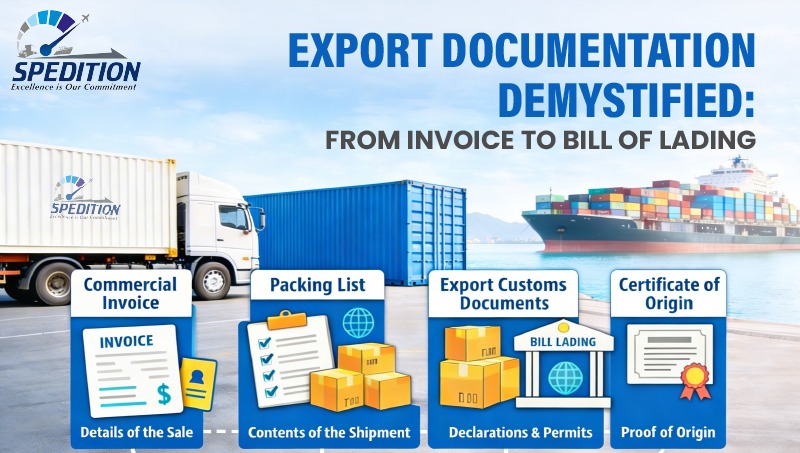
Commercial Invoice – The Foundation Document
If export documentation were a building, the commercial invoice would be the foundation.
What Is a Commercial Invoice
The exporter uses the commercial invoice document as a legal instrument to deliver goods from their company to the importer. The document functions as a description of the sold merchandise while creating a foundation for customs valuation purposes.
Key Elements of a Commercial Invoice
- Exporter & importer details
- Invoice number and date
- Description of goods
- HS code
- Quantity and unit price
- Total value
- Incoterms
- Country of origin
Common Mistakes to Avoid
- Incorrect HS codes
- Mismatch with packing list
- Wrong currency
- Incomplete buyer details
A small mistake here can snowball into major customs issues.
Packing List – More Than Just a Checklist
While the invoice talks money, the packing list talks logistics.
Purpose of a Packing List
The packing list contains complete details about the packaging methods used for the goods. The document serves as a resource for customs officials and freight forwarders and warehouse teams.
Difference Between Invoice and Packing List
| Commercial Invoice | Packing List |
| Focuses on value | Focuses on packaging |
| Used for customs valuation | Used for cargo handling |
| Shows price | Shows weight & dimensions |
Certificate of Origin
Ever wondered how countries know where your goods come from? Enter the Certificate of Origin.
What Is a Certificate of Origin?
It certifies the country where the goods were manufactured.
Why It Is Required
- Determines applicable customs duty
- Helps claim preferential tariff benefits
- Required by importing country authorities
Preferential vs Non-Preferential CO
- Preferential CO: Used under trade agreements
- Non-Preferential CO: General origin declaration
Shipping Bill / Export Declaration
This is where customs officially gets involved.
Role of Customs in Export Documentation
Customs uses the shipping bill to:
- Verify export details
- Assess duties (if any)
- Record export data
Filing the Shipping Bill
Filed electronically in most countries, it includes:
- Exporter details
- Invoice value
- HS code
- Port of loading
Bill of Lading – The Most Critical Document
If export documents had a superstar, this would be it.
What Is a Bill of Lading
A Bill of Lading (B/L) is issued by the carrier and acts as:
- Proof of shipment
- Receipt of goods
- Document of title
Functions of a Bill of Lading
It allows the importer to claim goods and proves ownership during transit.
Types of Bill of Lading
- Clean B/L
- Claused B/L
- Straight B/L
- Order B/L
Each type serves a specific commercial purpose.
Air Waybill vs Bill of Lading
Key Differences Explained
| Air Waybill | Bill of Lading |
| Used in air freight | Used in sea freight |
| Non-negotiable | Can be negotiable |
| Faster transit | Suitable for bulk cargo |
Insurance Certificate
International trade is risky. Insurance is your safety net.
Why Export Insurance Matters
It protects against:
- Damage
- Theft
- Loss during transit
What the Insurance Certificate Includes
- Policy number
- Coverage amount
- Risks covered
- Shipment details
Letter of Credit and Supporting Documents
Understanding LC in Exports
A Letter of Credit (LC) ensures the exporter gets paid—provided documents are compliant.
Document Compliance Under LC
Banks are strict. Even a spelling mistake can delay payment. Precision is everything.
Other Important Export Documents
Inspection Certificate
Confirms goods meet required standards.
Export License
Mandatory for restricted goods.
Fumigation Certificate
Required for wooden packaging materials.
Digitalization of Export Documentation
Paperless Trade and E-Documents
Export documentation is going digital—and fast.
Benefits of Digital Export Documentation
- Faster processing
- Fewer errors
- Better tracking
- Cost savings
Common Export Documentation Errors
How Errors Impact Shipments
- Customs delays
- Penalties
- Payment issues
- Loss of buyer trust
Tips to Avoid Costly Mistakes
- Double-check data
- Keep documents consistent
- Stay updated on regulations
Best Practices for Managing Export Documents
Creating a Documentation Checklist
A checklist ensures nothing slips through the cracks.
Working with Freight Forwarders
Experienced logistics partners simplify documentation and reduce risk.
Conclusion
The complex appearance of export documentation actually remains understandable for all users. Your shipment control system requires you to understand every document starting from the commercial invoice and ending with the bill of lading. Your export documentation functions as your permanent export path. The process becomes simpler to handle as you follow the documentation path which leads to successful global trade operations.
FAQs
- What is the most important export document?
The commercial invoice and bill of lading are considered the most critical. - Can incorrect documentation delay shipments?
Yes, even minor errors can cause major customs delays. - Is a packing list mandatory for exports?
While not always legally mandatory, it is practically essential. - What is the difference between B/L and Air Waybill?
A B/L is negotiable and used in sea freight, while an AWB is non-negotiable and used in air freight. - How can exporters reduce documentation errors?
By using digital tools, checklists, and experienced freight forwarders.