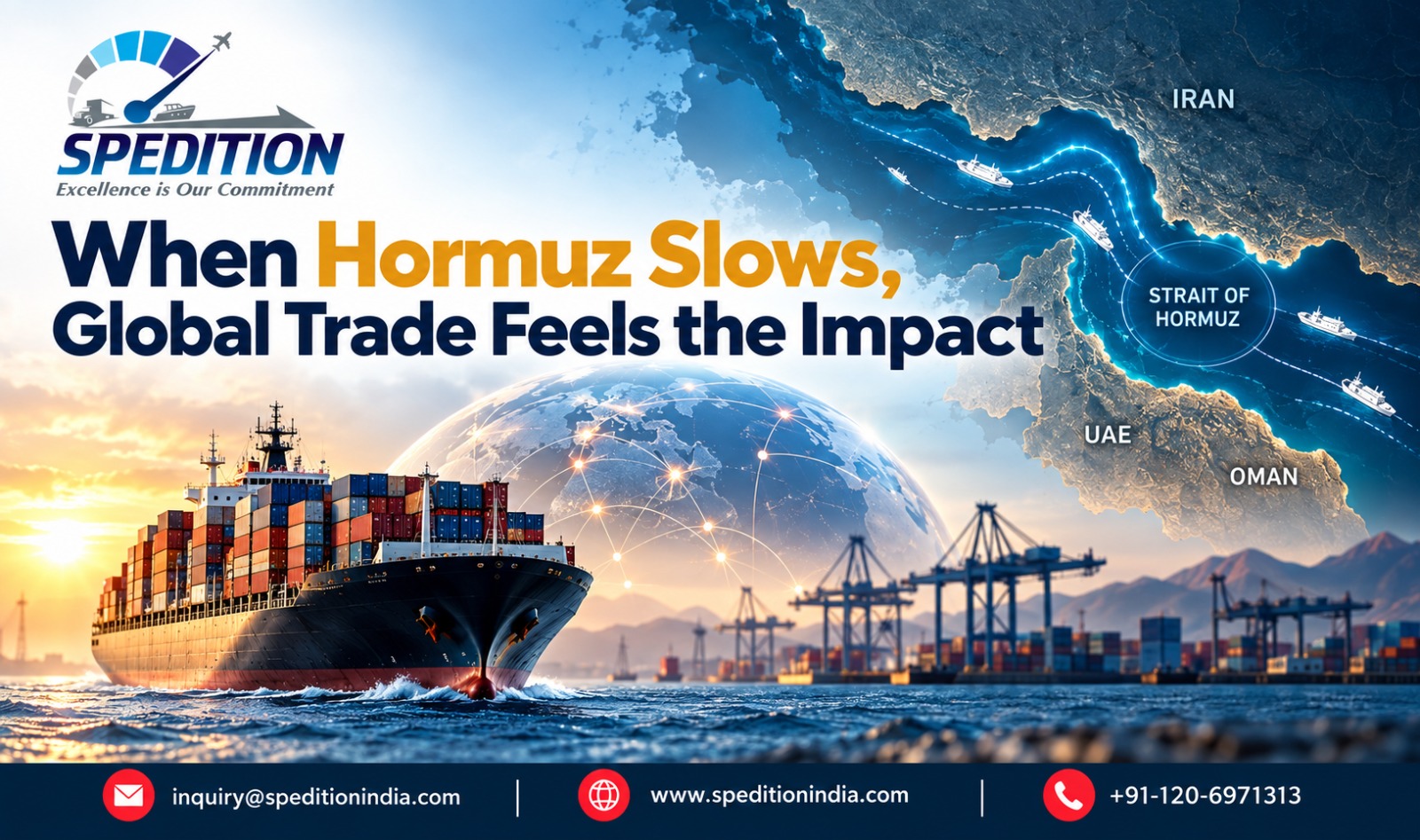
When Hormuz Slows, Global Trade Feels the Impact
The Strait of Hormuz has long been one of the most important gateways for global energy and maritime trade. Today, its significance is being highlighted by an unprecedented slowdown in vessel movement.
On September 10, just 7 vessels transited the Strait of Hormuz, compared with a recent 10-day average of 15. Before the current conflict, the waterway typically handled around 125 large commercial vessels a day.
For global logistics, the numbers point to more than a regional shipping disruption. They signal growing uncertainty around energy flows, freight planning, vessel availability and supply-chain reliability.
Why the Strait of Hormuz Matters
The Strait is only around 21 nautical miles wide at its narrowest point, with designated shipping channels for vessels moving in and out. Yet its importance to global trade is far greater than its physical size.
According to the International Energy Agency (IEA), an average of around 20 million barrels of oil per day moved through the Strait in 2025 — equivalent to approximately 25% of global seaborne oil trade.
And the dependence is heavily concentrated in Asia. Around 80% of the oil moving through Hormuz is destined for Asian markets, with China and India among the largest destinations.
This makes disruption in the Strait particularly relevant for Asian importers, manufacturers and logistics networks.
The Scale of the Disruption
Recent vessel-tracking data gives a clear indication of how sharply traffic has changed.
7 vessels crossed the Strait on September 10, against a 10-day average of 15 and a pre-conflict norm of around 125 large commercial vessels per day.
The impact is also visible in energy flows.
EIA data shows that total oil flows through the Strait fell from 21.6 million barrels per day in Q4 2025 to 4.9 million barrels per day in Q2 2026. That represents a reduction of roughly 77%.
21.6M → 4.9M barrels per day
Oil flows through the Strait of Hormuz, Q4 2025 to Q2 2026
For businesses, this scale of change can translate into greater volatility in fuel prices, vessel movements, freight planning and transportation costs.
The LNG Risk Is Particularly Relevant for Asia
Hormuz is not only an oil route.
The IEA estimates that more than 112 billion cubic metres of LNG transited the Strait in 2025, representing almost 20% of global LNG trade. Nearly 90% of LNG volumes exported through the Strait were destined for Asian markets.
India’s exposure is significant. Along with Bangladesh and Pakistan, India imported almost two-thirds of its total LNG supplies through the Strait in 2025, according to the IEA.
That makes the disruption relevant not just to energy companies, but to industries where energy availability and pricing influence production and operating costs.
What Falling Vessel Traffic Means for Shipping
When vessels cannot rely on a major maritime corridor, the consequences extend across the wider shipping network.
Carriers and cargo owners may need to reassess:
- Vessel schedules and routing
- Transit-time commitments
- Freight and insurance costs
- Fuel requirements
- Port and transshipment options
- Inventory and delivery planning
And alternative routes are not necessarily cost-neutral.
UNCTAD has highlighted how previous geopolitical disruptions forced vessels onto longer routes, increasing sailing distances, fuel consumption, operating costs and pressure on available shipping capacity. Its 2025 Review of Maritime Transport notes that rerouting contributed to a 5.9% increase in global ton-miles in 2024, almost three times the growth in actual trade volume.
The lesson is important: when a major shipping route changes, the impact does not stop at the route itself. It travels through the wider logistics network.
The Ripple Effect on Freight Forwarding
For freight forwarders, this environment makes route planning more strategic.
A shipment that was previously straightforward may now require closer evaluation of alternative ports, connecting services, transit times and overall landed costs.
It also makes communication more important. Importers and exporters need greater visibility into changing schedules and enough flexibility to adjust when market conditions shift.
The objective is not simply to find the shortest route. It is to find the most reliable and commercially viable route under the circumstances.
Supply Chains Need More Flexibility
The disruption around Hormuz also reinforces a broader lesson for international trade: resilience cannot depend on a single route.
Businesses can strengthen their logistics planning by:
- Evaluating alternative ports and shipping corridors
- Building realistic buffers into delivery schedules
- Monitoring freight, fuel and capacity movements
- Reviewing multimodal transportation options
- Maintaining close coordination with logistics partners
- Planning contingencies for high-risk trade lanes
This becomes particularly important for businesses whose supply chains stretch across multiple countries and depend on predictable maritime connections.
What Lies Ahead for Global Shipping
The immediate situation around Hormuz remains fluid, but the broader implications for global logistics are already becoming clearer.
The IEA notes that while some oil can be redirected through alternative pipeline routes, available bypass capacity is estimated at only 3.5–5.5 million barrels per day — significantly below normal volumes moving through the Strait.
That limited flexibility means prolonged disruption could continue putting pressure on energy markets and, indirectly, on transportation and logistics costs.
For businesses, the priority is therefore shifting from simply optimising cost to balancing cost, reliability, risk and resilience.
Supporting Smarter Global Logistics
At Spedition India, we understand that effective international logistics requires more than simply choosing a shipping route.
From sea freight and air freight to customised logistics solutions, we help businesses evaluate routes, transit times, costs and operational risks to keep their supply chains moving in an evolving global trade environment.
Looking for the right route for your next shipment?
Connect with Spedition India to explore a logistics solution built around your cargo, destination and timeline.
📩 inquiry@speditionindia.com 🌐 www.speditionindia.com 📞 +91-120-697131