Skip to Content

Blog Archives

February 13, 2026

Export Documentation Demystified: From Invoice to Bill of Lading

Introduction to Export Documentation

The export process creates exciting opportunities for businesses to enter new markets while serving customers across the world. People need to understand that documentation requirements create a complex system which they must navigate. Your shipment will remain at customs because of one missing detail or one incorrect document.

The export documentation system requires comprehensive understanding which serves as a fundamental requirement for export activities.

Why Export Documentation Matters

Export documents are the backbone of international trade. They ensure:

  • Smooth customs clearance
  • Legal compliance
  • Accurate payment
  • Proof of ownership and shipment

Think of export documents as the language global trade speaks. If you speak it fluently, business flows. If not, delays and losses follow.

Common Challenges Faced by Exporters

Most exporters struggle with:

  • Too many documents
  • Changing regulations
  • Country-specific requirements
  • Errors in invoices or shipping papers

But the good news? Once you understand the purpose of each document, everything starts to make sense.

Understanding the Export Process

Before diving into individual documents, let’s zoom out.

Step-by-Step Overview of an Export Shipment

  1. Order confirmation
  2. Goods manufacturing and packing
  3. Documentation preparation
  4. Customs clearance
  5. Shipment dispatch
  6. Delivery to the importer

Where Documentation Fits into the Process

Documentation isn’t one step—it runs through the entire export cycle. From pricing the product to delivering it overseas, documents guide every move.

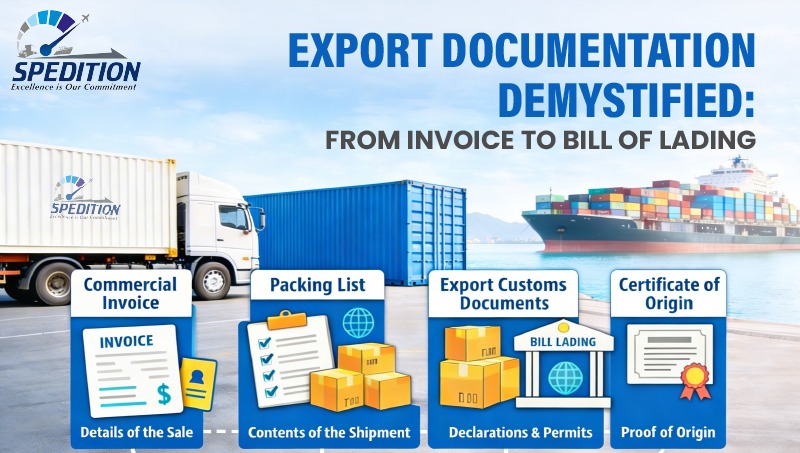
Commercial Invoice – The Foundation Document

If export documentation were a building, the commercial invoice would be the foundation.

What Is a Commercial Invoice

The exporter uses the commercial invoice document as a legal instrument to deliver goods from their company to the importer. The document functions as a description of the sold merchandise while creating a foundation for customs valuation purposes.

Key Elements of a Commercial Invoice

  • Exporter & importer details
  • Invoice number and date
  • Description of goods
  • HS code
  • Quantity and unit price
  • Total value
  • Incoterms
  • Country of origin

Common Mistakes to Avoid

  • Incorrect HS codes
  • Mismatch with packing list
  • Wrong currency
  • Incomplete buyer details

A small mistake here can snowball into major customs issues.

Packing List – More Than Just a Checklist

While the invoice talks money, the packing list talks logistics.

Purpose of a Packing List

The packing list contains complete details about the packaging methods used for the goods. The document serves as a resource for customs officials and freight forwarders and warehouse teams.

Difference Between Invoice and Packing List

Commercial Invoice Packing List
Focuses on value Focuses on packaging
Used for customs valuation Used for cargo handling
Shows price Shows weight & dimensions


Certificate of Origin

Ever wondered how countries know where your goods come from? Enter the Certificate of Origin.

What Is a Certificate of Origin?

It certifies the country where the goods were manufactured.

Why It Is Required

  • Determines applicable customs duty
  • Helps claim preferential tariff benefits
  • Required by importing country authorities

Preferential vs Non-Preferential CO

  • Preferential CO: Used under trade agreements
  • Non-Preferential CO: General origin declaration

Shipping Bill / Export Declaration

This is where customs officially gets involved.

Role of Customs in Export Documentation

Customs uses the shipping bill to:

  • Verify export details
  • Assess duties (if any)
  • Record export data

Filing the Shipping Bill

Filed electronically in most countries, it includes:

  • Exporter details
  • Invoice value
  • HS code
  • Port of loading

Bill of Lading – The Most Critical Document

If export documents had a superstar, this would be it.

What Is a Bill of Lading

A Bill of Lading (B/L) is issued by the carrier and acts as:

  1. Proof of shipment
  2. Receipt of goods
  3. Document of title

Functions of a Bill of Lading

It allows the importer to claim goods and proves ownership during transit.

Types of Bill of Lading

  • Clean B/L
  • Claused B/L
  • Straight B/L
  • Order B/L

Each type serves a specific commercial purpose.

Air Waybill vs Bill of Lading

Key Differences Explained

Air Waybill Bill of Lading
Used in air freight Used in sea freight
Non-negotiable Can be negotiable
Faster transit Suitable for bulk cargo

Insurance Certificate

International trade is risky. Insurance is your safety net.

Why Export Insurance Matters

It protects against:

  • Damage
  • Theft
  • Loss during transit

What the Insurance Certificate Includes

  • Policy number
  • Coverage amount
  • Risks covered
  • Shipment details

Letter of Credit and Supporting Documents

Understanding LC in Exports

A Letter of Credit (LC) ensures the exporter gets paid—provided documents are compliant.

Document Compliance Under LC

Banks are strict. Even a spelling mistake can delay payment. Precision is everything.

Other Important Export Documents

Inspection Certificate

Confirms goods meet required standards.

Export License

Mandatory for restricted goods.

Fumigation Certificate

Required for wooden packaging materials.

Digitalization of Export Documentation

Paperless Trade and E-Documents

Export documentation is going digital—and fast.

Benefits of Digital Export Documentation

  • Faster processing
  • Fewer errors
  • Better tracking
  • Cost savings

Common Export Documentation Errors

How Errors Impact Shipments

  • Customs delays
  • Penalties
  • Payment issues
  • Loss of buyer trust

Tips to Avoid Costly Mistakes

  • Double-check data
  • Keep documents consistent
  • Stay updated on regulations

Best Practices for Managing Export Documents

Creating a Documentation Checklist

A checklist ensures nothing slips through the cracks.

Working with Freight Forwarders

Experienced logistics partners simplify documentation and reduce risk.

Conclusion

The complex appearance of export documentation actually remains understandable for all users. Your shipment control system requires you to understand every document starting from the commercial invoice and ending with the bill of lading. Your export documentation functions as your permanent export path. The process becomes simpler to handle as you follow the documentation path which leads to successful global trade operations.

FAQs

  1. What is the most important export document?
    The commercial invoice and bill of lading are considered the most critical.
  2. Can incorrect documentation delay shipments?
    Yes, even minor errors can cause major customs delays.
  3. Is a packing list mandatory for exports?
    While not always legally mandatory, it is practically essential.
  4. What is the difference between B/L and Air Waybill?
    A B/L is negotiable and used in sea freight, while an AWB is non-negotiable and used in air freight.
  5. How can exporters reduce documentation errors?
    By using digital tools, checklists, and experienced freight forwarders.
0 0 Continue Reading →

How Small Manufacturers Can Compete with Big Brands Using Smart Logistics

How Small Manufacturers Can Compete with Big Brands Using Smart Logistics

Introduction – When Size Is Not the Only Advantage

In today’s competitive manufacturing landscape, small manufacturers often feel overshadowed by big brands. Large companies have massive production capacities, nationwide warehouses, and deep pockets. But here’s the truth—success no longer depends on size alone but smart logistics. It depends on how smartly you move your goods.

Big Brands vs Small Manufacturers

The scale is the reason for the dominance of big brands, but small manufacturers are endowed with an equally powerful attribute—flexibility. This flexibility, combined with the right logistics partner like Spedition India, Results in a strong competitive advantage.

Why Logistics Is the Real Game Changer

Logistics has transformed from merely being a transportation concern to being a whole package of speed, visibility, cost management, and customer satisfaction. By the use of intelligent logistics, even small manufacturers will be able to run neck to neck with the major players in the industry.

The Role of Smart Logistics in Modern Manufacturing

What Smart Logistics Means Today

Smart logistics refers to an area that applies the ideal amalgamation of technology, data, and strategic elements to guarantee that goods move smoothly through the supply chain.

Traditional Logistics vs Smart Logistics

Traditional logistics reacts to problems. Smart logistics anticipates them. With Spedition India’s technology-driven approach, manufacturers gain control instead of chaos.

Why Logistics Determines Market Success

Late deliveries, high costs, or damaged goods can cost customers. Smart logistics ensures reliability—something modern buyers value deeply.

Challenges Faced by Small Manufacturers in India

Rising Freight and Fuel Costs

The advent of unplanned transportation could be severely detrimental to margins. Without shared delivery and freight scheduling, costs would soar to unmanageable levels.

Limited Warehousing Infrastructure

The expenses of operating warehouses together with inefficient storage operations handling hinder business activities.

Poor Supply Chain Visibility

Not knowing where shipments are leads to missed deadlines and unhappy customers.

How Big Brands Dominate Through Logistics

Scale and Cost Advantages

Big brands ship in bulk and negotiate better rates.

Integrated Logistics Networks

Their network systems create strong connections between ports and highways and urban areas.

Technology-Driven Operations

The company uses automation together with analytics to maintain its competitive advantage.

How Spedition India Levels the Playing Field

Customized Logistics Solutions

Spedition India understands that no two manufacturers are the same. Solutions are tailored to specific business needs.

Multi-Modal Transportation Expertise

By combining road, rail, sea, and air freight, Spedition India ensures cost-effective and reliable movement of goods.

End-to-End Supply Chain Management

From pickup to final delivery, Spedition India manages the entire logistics lifecycle.

Turning Agility into a Competitive Advantage

Faster Response to Market Demand

Small manufacturers can adapt quickly—and Spedition India ensures smart logistics keeps pace.

Flexible Logistics Planning with Spedition India

Seasonal demand spikes? New markets? Spedition adjusts logistics plans without disruption.

Personalized Fulfilment Strategies

Unlike big brands, small manufacturers can offer personalized delivery experiences—supported by Spedition’s flexible logistics.

Technology-Driven Logistics by Spedition India

Real-Time Tracking and Visibility

The manufacturers receive absolute revelation regarding their transportations.

Data-Driven Decision Making

Statistical analysis aids in anticipating demand, organizing inventory properly, and minimizing risks.

Automation and Digital Documentation

Faster processing, fewer errors, and smoother operations.

Smart Inventory Management with Spedition India

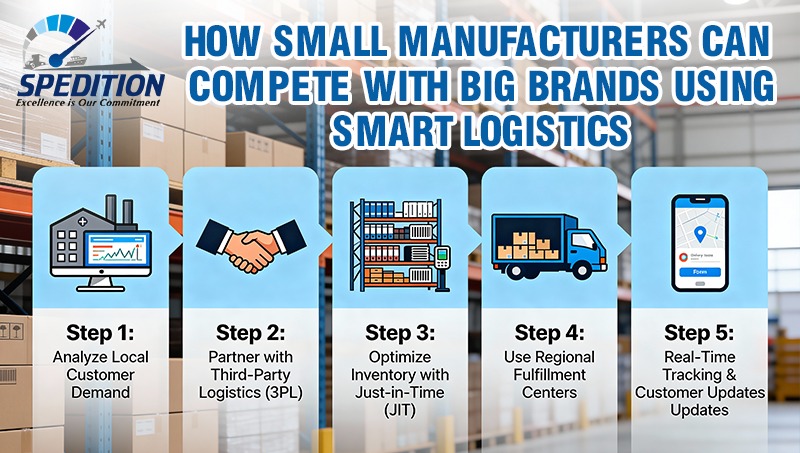
Just-in-Time Inventory Solutions

Reduce storage costs while ensuring timely availability of goods.

Demand Forecasting and Stock Optimization

Spedition India helps align inventory with real market demand.

Reducing Inventory Holding Costs

Less idle stock means better cash flow.

Cost-Efficient Transportation Solutions

Domestic and International Freight Services

Spedition India provides seamless logistics services for Indian domestic delivery and worldwide market distribution.

Multi-Modal Logistics for Cost Optimization

The correct transportation method used at the correct moment helps the business maintain its expenses.

Route Planning and Last-Mile Efficiency

The system uses efficient routes to deliver packages faster while maintaining dependable service.

Outsourcing Logistics – A Strategic Move

3PL and 4PL Solutions by Spedition India

Manufacturers can outsource complexity while maintaining control.

Benefits of Logistics Outsourcing for Manufacturers

Lower costs, expert handling, and scalability.

Focus on Core Manufacturing While Spedition Manages Logistics

Manufacturers focus on production—Spedition handles movement.

Smart Warehousing Solutions

Scalable Warehousing Options

Pay only for what you use.

Shared and On-Demand Storage

Ideal for growing and seasonal businesses.

Regional Warehousing for Faster Deliveries

Closer warehouses mean happier customers.

Enhancing Customer Experience through Logistics

Faster and Reliable Deliveries

Consistency builds trust.

Real-Time Shipment Updates

Customers stay informed at every step.

Seamless Reverse Logistics

Efficient returns strengthen brand credibility.

Sustainable Logistics as a Brand Advantage

Eco-Friendly Transportation Practices

Spedition India supports greener logistics solutions.

Optimized Routes to Reduce Emissions

Lower fuel consumption benefits both business and environment.

Supporting Green Manufacturing Goals

Sustainability adds long-term brand value.

Financial Benefits of Smart Logistics

Reduced Operational Costs

Optimized logistics operations bring about better financial outcomes because they eliminate unexpected events.

Predictable Logistics Expenses

Better planning equals better budgeting.

Improved Cash Flow and Working Capital

Faster deliveries lead to faster payments. The process results in money entering the business more quickly according to delivery time.

Real-World Scenarios – Small Manufacturers Growing with Spedition India

Scaling from Local to National Markets

Strategic warehousing and freight planning enable expansion.

Export Growth Through Smart Freight Planning

Spedition India simplifies global logistics for small manufacturers.

Building a Future-Ready Supply Chain with Spedition India

Logistics Planning for Business Expansion

Design supply chains that grow with demand.

Strategic Partnerships for Long-Term Growth

Spedition India acts as a logistics partner, not just a service provider.

Continuous Optimization and Innovation

Logistics evolves—and Spedition evolves with it.

Common Logistics Mistakes Small Manufacturers Should Avoid

Choosing Cost Over Reliability

Cheap logistics often leads to expensive problems.

Ignoring Supply Chain Data

Data-driven logistics wins every time.

Delaying Logistics Investments

Early planning saves long-term costs.

Conclusion – Spedition India as a Growth Partner

Small manufacturers now have the ability to compete against large brands. The smart logistics solutions of Spedition India enable manufacturers to achieve cost savings while their delivery speed improves and their business operations become more efficient and their customers experience greater satisfaction. Spedition India operates as a growth partner in markets where logistics serve as the main factor for business success.

FAQs

1. How does Spedition India help small manufacturers compete with big brands?

By offering radically tailored, technology-centred, and cost-effective logistic outcomes.

2. Is Spedition India suitable for small-scale manufacturers?
Yes, Spedition India provides scalable logistics tailored to business size and growth stage.

3. Does Spedition India offer multi-modal logistics?
Yes, road, rail, sea, and air freight solutions are available.

4. Can Spedition India support export logistics?
Absolutely. Spedition India offers international freight and export logistics support.

5. Why is smart logistics essential for modern manufacturing operations?

The system provides four benefits which include cost reduction efficiency improvement customer satisfaction enhancement and support for business growth through scalable solutions.

0 0 Continue Reading →
devnergy