Skip to Content

Blog Archives

India–New Zealand FTA Comes into Force: Key Implications for Businesses

India–New Zealand FTA Comes into Force: Key Implications for Businesses


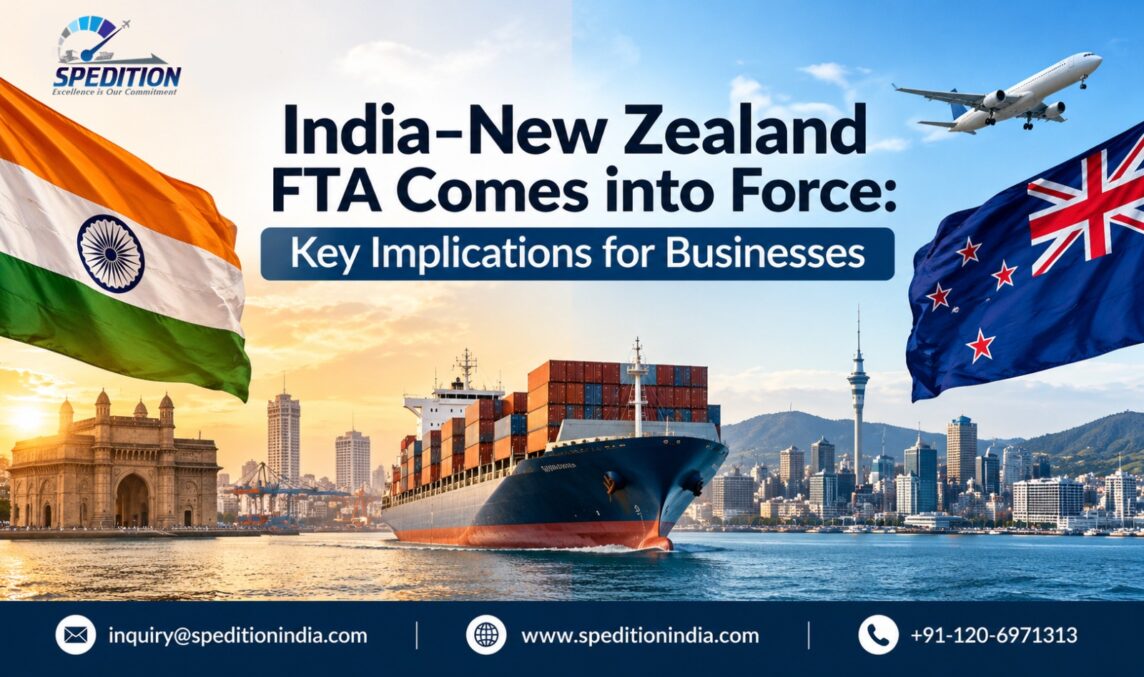
The India–New Zealand Free Trade Agreement (FTA), effective from 20 October 2026, opens new avenues for trade between the two countries. For businesses, it brings opportunities to expand market access, explore new sourcing partnerships and strengthen international supply chains.

As trade relations evolve, the focus extends beyond tariff benefits to the practical aspects of moving goods across borders. From freight planning and customs documentation to transportation and delivery coordination, efficient logistics will be essential to helping businesses make the most of these opportunities.

1. A New Chapter in India–New Zealand Trade

The implementation of the FTA marks an important step in strengthening economic ties between India and New Zealand. The agreement aims to make bilateral trade more accessible and competitive by reducing or eliminating customs duties on eligible goods.

A key highlight is that 100% of Indian export tariff lines receive duty-free access to the New Zealand market from day one. On the other side, New Zealand goods receive preferential access to India, with tariff reductions or elimination covering 95% of New Zealand’s current exports to India under the agreement. The benefits vary by product and implementation schedule. For businesses, this creates opportunities to reassess their international trade strategies, identify potential markets and build stronger commercial relationships.

2. What the FTA Means for Importers and Exporters

The agreement could influence how businesses approach pricing, sourcing and market expansion. Its practical impact will depend on the products involved and the applicable eligibility requirements.

Key opportunities for businesses include:

  • Greater export competitiveness: Duty-free access to New Zealand can help eligible Indian products compete more effectively on price.
  • Access to new markets: Exporters may find opportunities to connect with new buyers, distributors and business partners.
  • More sourcing options: Indian importers can explore eligible New Zealand products under preferential tariff arrangements.
  • Scope for business expansion: Manufacturers and trading companies can reassess their market strategies and explore new commercial relationships.
  • Stronger trade connections: Improved market access may encourage businesses to develop longer-term partnerships across both countries.

Sectors highlighted for Indian export opportunities include textiles, leather, footwear, engineering goods and agricultural processing, alongside other eligible product categories.

However, reduced tariffs do not automatically guarantee lower overall shipping costs or unrestricted market access. Businesses must also account for freight charges, applicable taxes and levies, product regulations and customs requirements.

3. Why Logistics Matters in the New Trade Landscape

A trade agreement can create new opportunities, but businesses still need a reliable way to move their products from one market to another. The right logistics approach helps connect commercial decisions with the practical realities of international shipping.

For shipments between India and New Zealand, four areas deserve particular attention.

Sea Freight: Planning for Volume and Cost

Sea freight can be a practical choice for larger consignments and regular commercial shipments where transit time allows.

Businesses should consider:

  • Container availability and cargo requirements.
  • Sailing schedules and estimated transit times.
  • Freight costs, port handling and destination charges.
  • Shipment planning to align with production and inventory cycles.

Advance planning can help businesses manage transportation costs and coordinate deliveries more effectively.

Air Freight: When Timing Matters

For urgent shipments, samples and high-value goods, air freight may be appropriate when speed is a priority.

The choice between air and sea freight should consider the urgency of delivery, cargo dimensions, shipment value and total transportation cost. Selecting the right mode helps businesses balance speed with their operational budgets.

Customs Clearance: Getting the Documentation Right

Preferential tariffs are available only when the relevant conditions are met. Accurate documentation and an understanding of the agreement’s rules are therefore essential.

Businesses should pay particular attention to:

  • Product classification: Verify the applicable Harmonized System (HS) code.
  • Rules of origin: Confirm that the goods qualify under the agreement.
  • Proof of origin: Arrange the required Certificate of Origin and supporting documents.
  • Customs requirements: Check applicable declarations, duties, taxes and product-specific regulations.

These checks can help reduce avoidable delays and support a smoother clearance process. The FTA does not remove all border checks or other regulatory obligations.

Supply Chain Coordination: Connecting Every Stage

International shipping involves several interconnected activities. When these are planned in isolation, businesses may face missed schedules, documentation gaps or unexpected costs.

Effective coordination helps businesses manage:

  • Freight bookings and transportation schedules.
  • Documentation and customs-related requirements.
  • Communication between suppliers, logistics partners and consignees.
  • Shipment tracking and delivery planning.

A coordinated approach provides greater visibility across the shipping process and helps businesses respond to operational changes more effectively.

4. How Businesses Can Prepare to Benefit from the FTA

Companies looking to trade between India and New Zealand can take practical steps to assess the opportunities available to them.

A useful starting point is to focus on five priorities:

  1. Review product eligibility. Check the applicable tariff schedule and confirm whether the goods qualify for preferential treatment.
  2. Understand the rules of origin. Ensure that products meet the relevant requirements and that the necessary proof of origin is available.
  3. Calculate the total landed cost. Consider freight, insurance, customs duties, taxes, handling and other applicable charges before finalising pricing.
  4. Choose the right shipping method. Evaluate sea and air freight options according to shipment size, delivery deadlines and budget.
  5. Plan the supply chain in advance. Align shipment schedules, inventory needs and documentation with the requirements of the destination market.

Taking these steps can help businesses make informed decisions and avoid treating tariff reductions as the only factor in their international trade strategy.

5. Looking Ahead: Turning Trade Opportunities into Business Growth

The India–New Zealand FTA creates a stronger foundation for bilateral trade and offers businesses new reasons to explore international partnerships. Yet, the long-term value of the agreement will depend on how effectively companies translate improved market access into commercially viable trade.

Reliable transportation, careful documentation, regulatory compliance and well-planned supply chains will continue to play an important role in this process.

At Spedition, we understand that every shipment comes with its own requirements. Effective freight coordination and careful planning help businesses navigate the complexities of international cargo movement and keep their supply chains connected.

As trade between India and New Zealand develops, businesses that combine informed market decisions with efficient logistics planning will be better positioned to explore new opportunities and manage cross-border shipments with confidence.

Looking to move your cargo across international markets? Connect with Spedition to discuss your freight forwarding requirements.

📩 inquiry@speditionindia.com 🌐 www.speditionindia.com 📞 +91-120-6971313
0 0 Continue Reading →

Crude, Conflict & Cargo: The Oil Story Shaping Global Trade

Crude, Conflict & Cargo: The Oil Story Shaping Global Trade


Oil prices have eased slightly, but the global trade story is far from settled.

On October 5, Brent crude was trading around $101.70 per barrel, while WTI stood near $90.27. The softer prices came as additional Middle Eastern crude entered the market and G7 nations moved to release 100 million barrels of crude and diesel from emergency reserves.

For global logistics, however, the bigger question is not simply where oil prices are today. It is how geopolitical uncertainty is changing the way cargo moves across the world.

When Oil Moves, Logistics Feels the Impact

Fuel is closely tied to the economics of transportation.

Changes in crude prices can eventually influence:

  • Ocean freight and bunker costs
  • Air cargo operating costs
  • Road transportation expenses
  • Manufacturing and distribution costs
  • Import costs for energy-dependent economies

But the relationship isn’t always immediate. Even when crude prices fall, freight costs may remain elevated if vessels are taking longer or less efficient routes.

That is exactly what makes the current situation important for global trade.

More Oil Supply, But Routes Remain Under Pressure

The latest decline in crude prices has been supported by higher Middle Eastern exports and the planned release of strategic reserves.

Yet geopolitical risks around the Gulf haven’t disappeared.

Shipping through the Strait of Hormuz continues to face security concerns, while some Middle Eastern crude is still moving at higher costs and through less efficient routes. For logistics operators, this creates a difficult equation:

More supply does not automatically mean smoother movement.

A shipment can have sufficient cargo availability but still face higher insurance costs, route changes, longer transit times or schedule uncertainty.

The Hidden Cost of Geopolitical Risk

When a major trade corridor becomes uncertain, the impact spreads beyond energy.

Businesses may have to deal with:

Longer Routes Vessel diversions can increase sailing distances and fuel consumption.

Higher Insurance Costs Greater security risks can push up premiums for vessels and cargo.

Transit Uncertainty Changes in routing can make delivery timelines harder to predict.

Freight Volatility Carriers may adjust rates depending on fuel, capacity and operational risk.

Inventory Pressure Longer or uncertain transit times can force businesses to hold additional stock.

This is why geopolitical developments in one region can quickly become a supply-chain concern for businesses thousands of kilometres away.

What Does This Mean for India?

India remains particularly sensitive to movements in global energy markets because crude oil is a major import.

With oil still hovering around the $100-per-barrel mark, sustained high prices can put pressure on India’s import bill, transportation costs and the rupee. The rupee opened around ₹96.20 to the US dollar on October 5, with high crude prices among the factors weighing on sentiment.

For Indian importers and exporters, this makes cost visibility and logistics planning increasingly important.

Cargo Planning Needs to Look Beyond Freight Rates

The current oil market highlights an important shift in how businesses should approach international logistics.

It is no longer enough to ask:

“What is the cheapest freight option?”

Businesses also need to consider:

  • Is the route reliable?
  • Could geopolitical conditions change the transit time?
  • Are alternative routes available?
  • How exposed is the shipment to fuel-price volatility?
  • Can the logistics plan be adjusted quickly if conditions change?

A slightly cheaper route may not necessarily be the most cost-effective option if it comes with significantly higher uncertainty.

What Businesses Should Watch Next

The coming weeks will remain important for global trade.

Key factors to watch include:

  • Crude oil prices and their impact on transportation costs
  • Strait of Hormuz developments and vessel movement
  • Middle Eastern crude exports and supply stability
  • Strategic reserve releases and their effect on global prices
  • Freight and insurance costs across affected trade lanes
  • Alternative routing options for businesses moving cargo through vulnerable corridors

The Bigger Lesson for Global Trade

The latest movement in oil prices offers some short-term relief, but it also reinforces a larger lesson:

Supply-chain resilience is not about predicting every disruption. It is about being prepared when conditions change.

For exporters, importers and logistics partners, having multiple routing options, real-time visibility and contingency plans can make the difference between a manageable disruption and a costly delay.

At Spedition, we believe every shipment needs more than a route, it needs a plan that can adapt.

As crude prices, geopolitical conditions and shipping routes continue to evolve, businesses need logistics strategies built around visibility, flexibility and resilience.

📩 inquiry@speditionindia.com 🌐 www.speditionindia.com 📞 +91-120-6971313
0 0 Continue Reading →

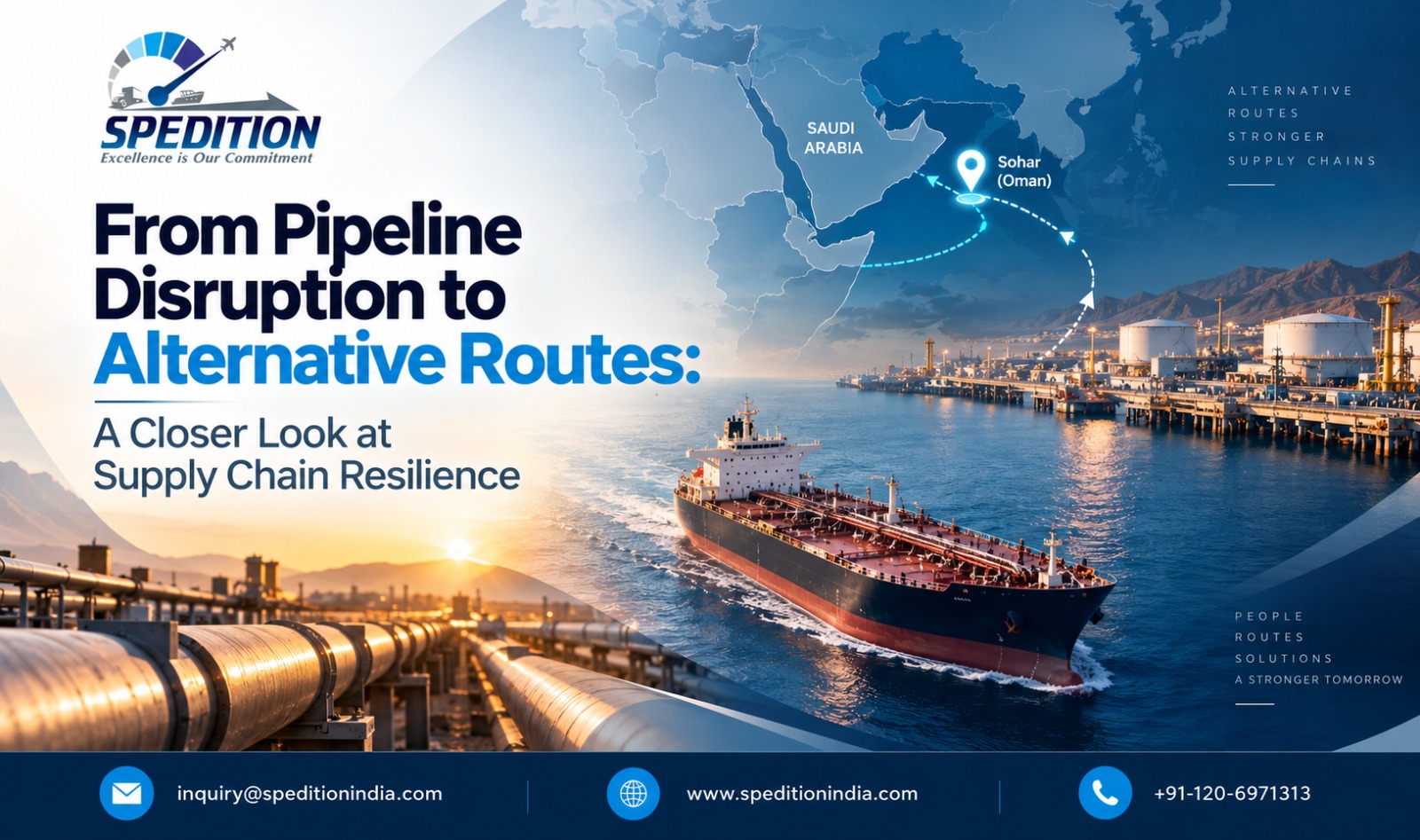
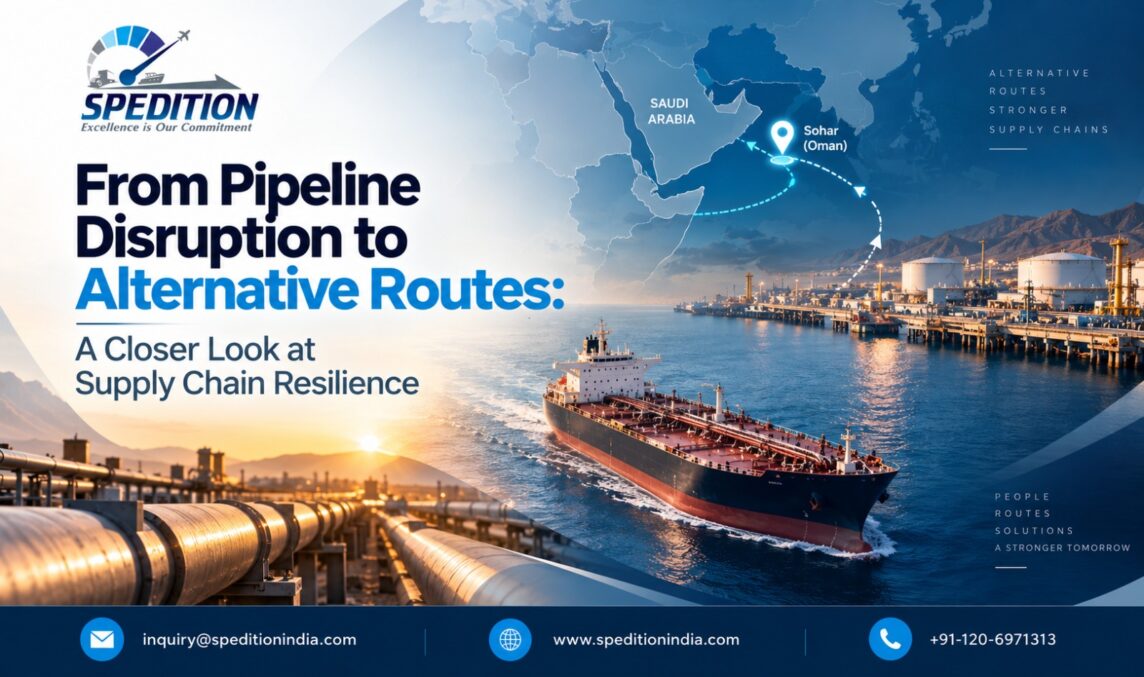
From Pipeline Disruption to Alternative Routes: A Closer Look at Supply Chain Resilience

From Pipeline Disruption to Alternative Routes: A Closer Look at Supply Chain Resilience


A disruption to one major oil pipeline is highlighting a much bigger reality of global trade:

When a critical route is affected, supply chains have to adapt quickly.

Saudi Arabia is exploring alternative ways to move crude after attacks disrupted its East-West pipeline and affected operations at Yanbu. One option involves routing additional crude through Oman’s Sohar port, including ship-to-ship transfers.

Oil prices eased as alternative supply options helped reduce immediate concerns about a prolonged shortage.

But for logistics, the bigger question is:

What happens when the usual route is no longer available?

What Changes When a Route Is Disrupted?

Changing a logistics route can trigger several knock-on effects:

  • 🚢 Different ports: Cargo may need to move through alternative gateways.
  • 🔄 Additional handling: Ship-to-ship transfers or transshipment may become necessary.
  • ⏱️ Transit uncertainty: Alternative routes can affect delivery schedules.
  • 💰 Higher costs: Freight, insurance, fuel and handling costs can increase.
  • 📦 Capacity pressure: New routes may not have immediate capacity for additional cargo.
  • 📋 More coordination: Documentation, customs and operational planning can become more complex.

So while the cargo may still be available, getting that cargo to its destination can become considerably more challenging.

Why This Matters Beyond Oil

The same supply-chain dynamics apply across industries.

A disruption to a:

  • Port
  • Pipeline
  • Canal
  • Shipping corridor
  • Rail connection
  • Road network

can quickly affect:

Routing → Transit Time → Freight Cost → Inventory → Customer Delivery

That is why businesses increasingly need to think beyond a single preferred route.

The question is not only:

“What is the fastest route?”

It is also:

“What is our next-best route if conditions change?”

🇮🇳 What Does It Mean for India?

India’s dependence on imported crude makes developments in Middle Eastern energy logistics particularly relevant.

With Saudi crude supplies facing disruption, Indian refiners are looking for replacement supplies. However, alternative barrels can involve higher procurement and freight costs.

For Indian businesses, the situation highlights three important considerations:

  • Supply availability — Can the required cargo still be sourced?
  • Route availability — Can it reach India reliably?
  • Landed cost — What will the complete cost be after freight, insurance and handling?

Cargo availability ≠ Logistics availability

A product can be available in the market while its transportation becomes more expensive, slower or less predictable.

How Can Businesses Build Resilience?

A resilient supply chain doesn’t depend on one solution.

1. Diversify Routes

Keep alternative ports, carriers and trade lanes identified in advance.

2. Maintain Visibility

Track:

  • Vessel movements
  • Port conditions
  • Route restrictions
  • Freight-rate changes
  • Geopolitical developments

3. Plan Capacity Early

When a major route is disrupted, alternative capacity can disappear quickly.

Early planning can help businesses avoid:

  • Last-minute bookings
  • Higher spot rates
  • Cargo rollovers
  • Unplanned storage

4. Look Beyond the Freight Rate

The cheapest freight option isn’t always the cheapest logistics solution.

Businesses should consider the total landed cost, including:

  • Freight
  • Fuel
  • Insurance
  • Port handling
  • Storage
  • Transshipment
  • Potential delay costs

5. Build Faster Decision-Making

During disruption, speed matters.

Having pre-evaluated alternatives allows logistics teams to respond rather than start planning from scratch.

The Bigger Logistics Lesson

Saudi Arabia’s response demonstrates an important principle of modern supply chains:

Resilience isn’t about avoiding disruption. It’s about being prepared to move differently when disruption happens.

Alternative routes may involve additional costs and complexity, but they can provide businesses with something equally valuable:

Continuity.

For global trade, flexibility is becoming just as important as efficiency.

At Spedition, we believe every shipment needs more than a route, it needs a plan that can adapt.

As trade lanes, freight markets and global conditions continue to evolve, the ability to identify and execute alternatives can make a meaningful difference.

Because when one route changes, the supply chain should already have another way forward.

📩 inquiry@speditionindia.com 🌐 www.speditionindia.com 📞 +91-120-697131

0 0 Continue Reading →

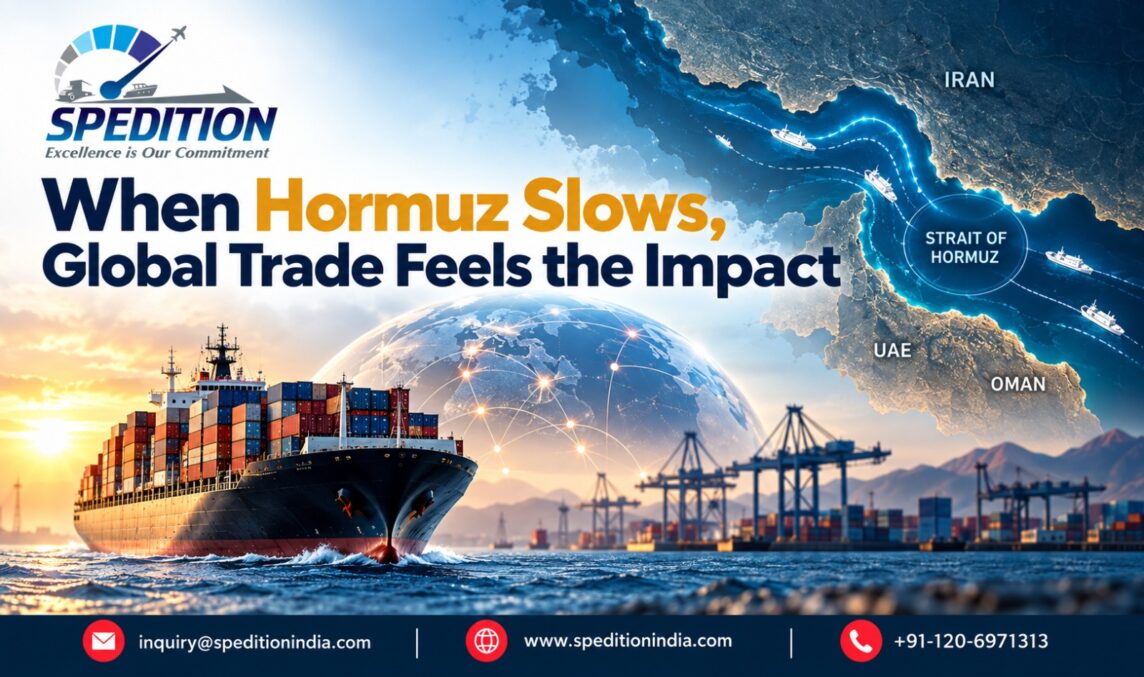
When Hormuz Slows, Global Trade Feels the Impact

When Hormuz Slows, Global Trade Feels the Impact

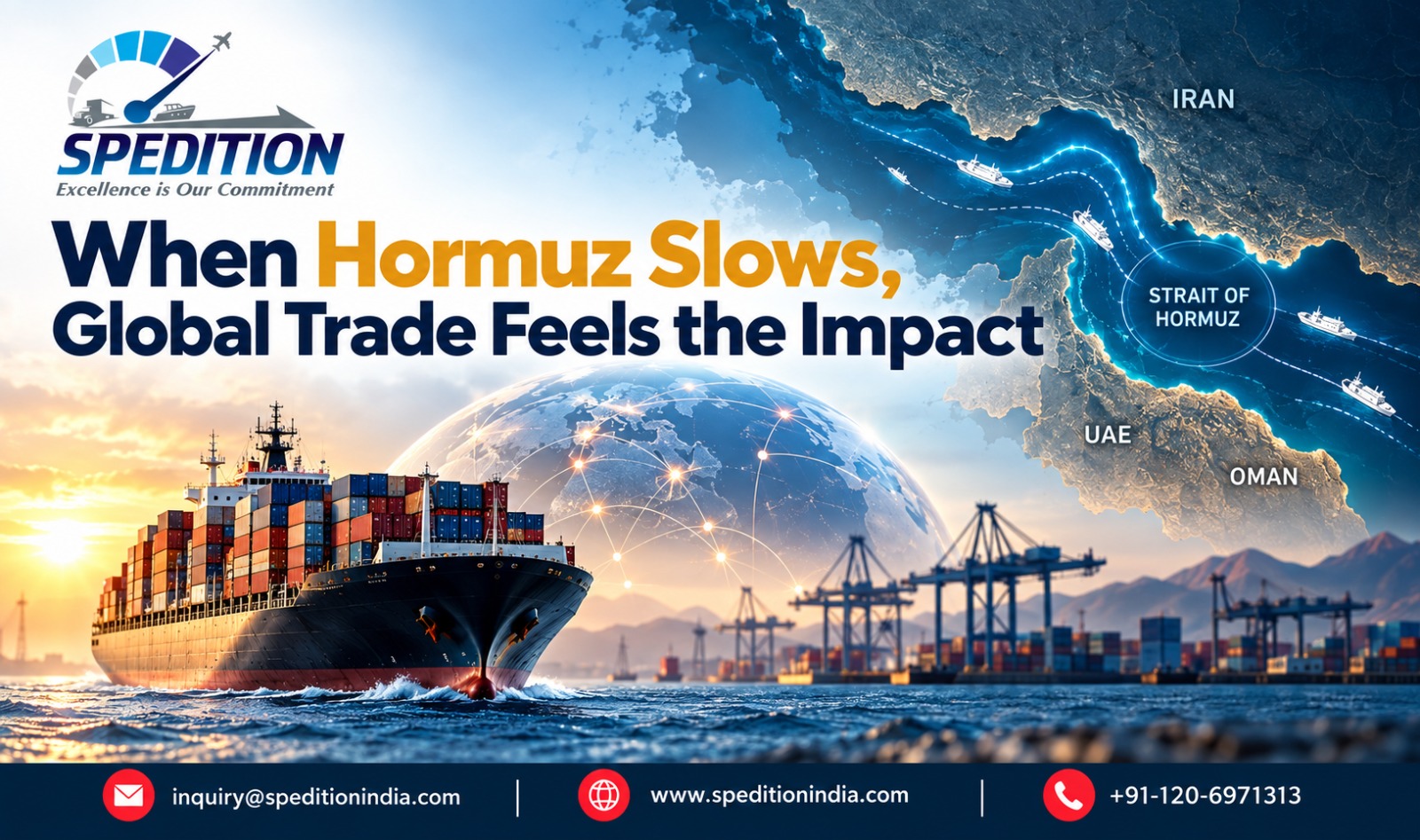
The Strait of Hormuz has long been one of the most important gateways for global energy and maritime trade. Today, its significance is being highlighted by an unprecedented slowdown in vessel movement.

On September 10, just 7 vessels transited the Strait of Hormuz, compared with a recent 10-day average of 15. Before the current conflict, the waterway typically handled around 125 large commercial vessels a day.

For global logistics, the numbers point to more than a regional shipping disruption. They signal growing uncertainty around energy flows, freight planning, vessel availability and supply-chain reliability.

Why the Strait of Hormuz Matters

The Strait is only around 21 nautical miles wide at its narrowest point, with designated shipping channels for vessels moving in and out. Yet its importance to global trade is far greater than its physical size.

According to the International Energy Agency (IEA), an average of around 20 million barrels of oil per day moved through the Strait in 2025 — equivalent to approximately 25% of global seaborne oil trade.

And the dependence is heavily concentrated in Asia. Around 80% of the oil moving through Hormuz is destined for Asian markets, with China and India among the largest destinations.

This makes disruption in the Strait particularly relevant for Asian importers, manufacturers and logistics networks.

The Scale of the Disruption

Recent vessel-tracking data gives a clear indication of how sharply traffic has changed.

7 vessels crossed the Strait on September 10, against a 10-day average of 15 and a pre-conflict norm of around 125 large commercial vessels per day.

The impact is also visible in energy flows.

EIA data shows that total oil flows through the Strait fell from 21.6 million barrels per day in Q4 2025 to 4.9 million barrels per day in Q2 2026. That represents a reduction of roughly 77%.

21.6M → 4.9M barrels per day

Oil flows through the Strait of Hormuz, Q4 2025 to Q2 2026

For businesses, this scale of change can translate into greater volatility in fuel prices, vessel movements, freight planning and transportation costs.

The LNG Risk Is Particularly Relevant for Asia

Hormuz is not only an oil route.

The IEA estimates that more than 112 billion cubic metres of LNG transited the Strait in 2025, representing almost 20% of global LNG trade. Nearly 90% of LNG volumes exported through the Strait were destined for Asian markets.

India’s exposure is significant. Along with Bangladesh and Pakistan, India imported almost two-thirds of its total LNG supplies through the Strait in 2025, according to the IEA.

That makes the disruption relevant not just to energy companies, but to industries where energy availability and pricing influence production and operating costs.

What Falling Vessel Traffic Means for Shipping

When vessels cannot rely on a major maritime corridor, the consequences extend across the wider shipping network.

Carriers and cargo owners may need to reassess:

  • Vessel schedules and routing
  • Transit-time commitments
  • Freight and insurance costs
  • Fuel requirements
  • Port and transshipment options
  • Inventory and delivery planning

And alternative routes are not necessarily cost-neutral.

UNCTAD has highlighted how previous geopolitical disruptions forced vessels onto longer routes, increasing sailing distances, fuel consumption, operating costs and pressure on available shipping capacity. Its 2025 Review of Maritime Transport notes that rerouting contributed to a 5.9% increase in global ton-miles in 2024, almost three times the growth in actual trade volume.

The lesson is important: when a major shipping route changes, the impact does not stop at the route itself. It travels through the wider logistics network.

The Ripple Effect on Freight Forwarding

For freight forwarders, this environment makes route planning more strategic.

A shipment that was previously straightforward may now require closer evaluation of alternative ports, connecting services, transit times and overall landed costs.

It also makes communication more important. Importers and exporters need greater visibility into changing schedules and enough flexibility to adjust when market conditions shift.

The objective is not simply to find the shortest route. It is to find the most reliable and commercially viable route under the circumstances.

Supply Chains Need More Flexibility

The disruption around Hormuz also reinforces a broader lesson for international trade: resilience cannot depend on a single route.

Businesses can strengthen their logistics planning by:

  • Evaluating alternative ports and shipping corridors
  • Building realistic buffers into delivery schedules
  • Monitoring freight, fuel and capacity movements
  • Reviewing multimodal transportation options
  • Maintaining close coordination with logistics partners
  • Planning contingencies for high-risk trade lanes

This becomes particularly important for businesses whose supply chains stretch across multiple countries and depend on predictable maritime connections.

What Lies Ahead for Global Shipping

The immediate situation around Hormuz remains fluid, but the broader implications for global logistics are already becoming clearer.

The IEA notes that while some oil can be redirected through alternative pipeline routes, available bypass capacity is estimated at only 3.5–5.5 million barrels per day — significantly below normal volumes moving through the Strait.

That limited flexibility means prolonged disruption could continue putting pressure on energy markets and, indirectly, on transportation and logistics costs.

For businesses, the priority is therefore shifting from simply optimising cost to balancing cost, reliability, risk and resilience.

Supporting Smarter Global Logistics

At Spedition India, we understand that effective international logistics requires more than simply choosing a shipping route.

From sea freight and air freight to customised logistics solutions, we help businesses evaluate routes, transit times, costs and operational risks to keep their supply chains moving in an evolving global trade environment.

Looking for the right route for your next shipment?

Connect with Spedition India to explore a logistics solution built around your cargo, destination and timeline.

📩 inquiry@speditionindia.com 🌐 www.speditionindia.com 📞 +91-120-697131

0 0 Continue Reading →

Vizhinjam Port Begins Full EXIM Operations: A New Gateway for India’s Global Trade

Vizhinjam Port Begins Full EXIM Operations: A New Gateway for India’s Global Trade

India’s maritime sector is entering a new chapter.

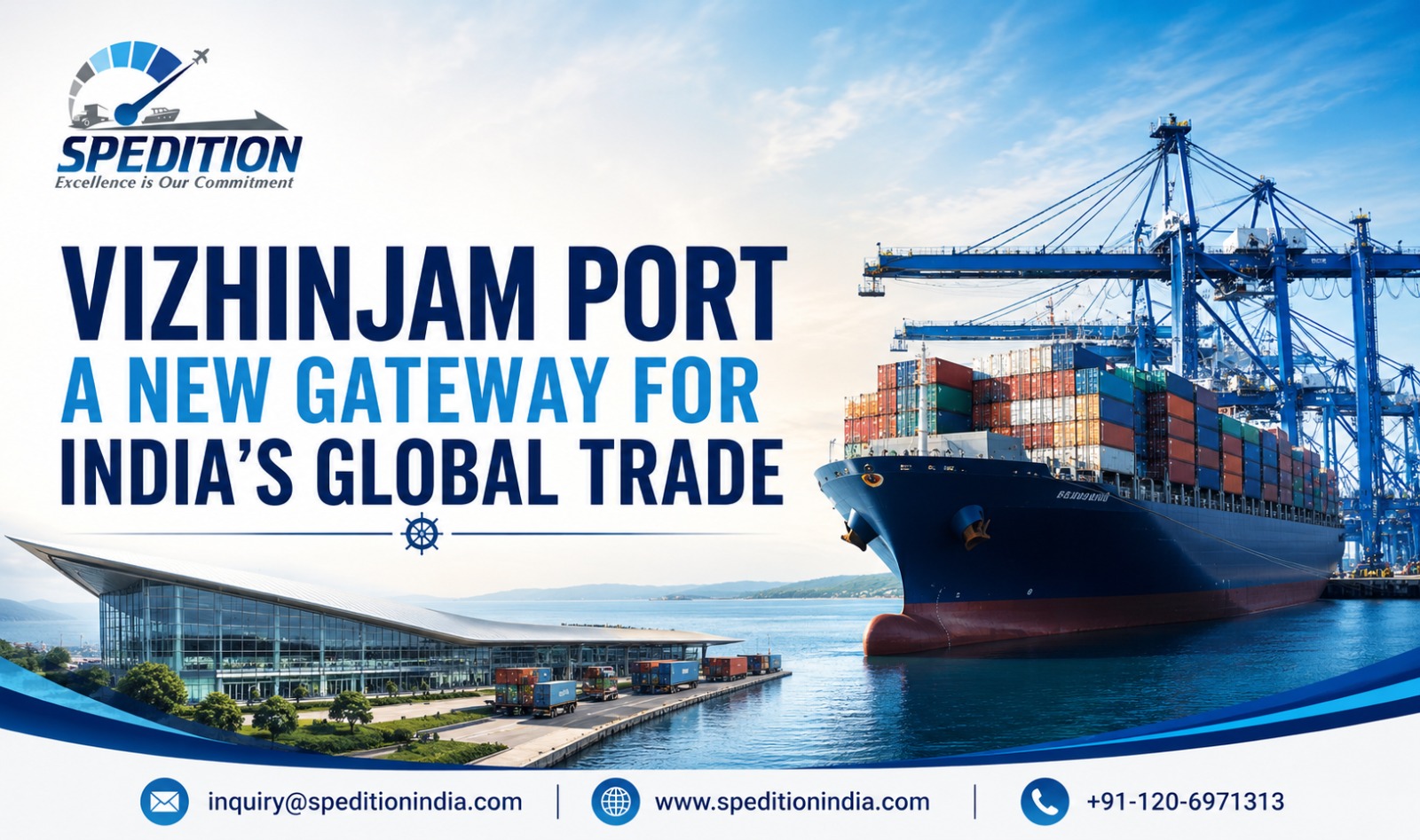
From 18 August 2026, the Vizhinjam International Seaport in Kerala will officially begin handling full Export-Import (EXIM) cargo operations, marking its transition from a transshipment hub to a fully operational international cargo gateway.

For exporters, importers, and logistics providers, this is more than just another port expansion, it’s a strategic development that could reshape cargo movement along India’s west coast.

What is changing?

Until now, Vizhinjam primarily handled ship-to-ship transshipment, where containers were transferred between international vessels.

With the launch of EXIM operations, the port will now directly handle:

  • Export cargo from Indian businesses
  • Import shipments arriving from global markets
  • Customs-cleared international cargo
  • End-to-end gateway logistics for domestic trade

This significantly expands the port’s role in India’s logistics ecosystem.

Why is Vizhinjam strategically important?

Vizhinjam is India’s first deep-water transshipment port, located just a few nautical miles from one of the world’s busiest east-west shipping lanes connecting Europe, the Middle East and Asia. Its natural deep draft allows it to accommodate some of the world’s largest container vessels with minimal dredging requirements.

This strategic location offers several advantages:

  • Reduced deviation time for mainline vessels
  • Faster vessel turnaround
  • Improved connectivity with global shipping routes
  • Greater potential to attract direct international services

What does this mean for Indian exporters?

The commencement of gateway EXIM services can create several long-term benefits:

Reduced dependence on foreign transshipment hubs

A significant share of India’s container cargo has traditionally been routed through ports such as Colombo before reaching global destinations. Expanding direct handling capacity within India can improve supply chain efficiency and strengthen national maritime capabilities.

Faster cargo movement

Direct export and import handling may reduce transit delays associated with multiple handling points, helping businesses improve shipment planning and delivery schedules.

Greater opportunities for southern India

Manufacturers and exporters across Kerala, Tamil Nadu and neighbouring regions may benefit from improved access to international shipping services through a closer gateway port.

A boost for India’s logistics ecosystem

The launch of EXIM operations aligns with India’s broader objective of strengthening port infrastructure, improving multimodal connectivity and enhancing global trade competitiveness.

As cargo volumes increase, the development is also expected to encourage:

  • Logistics investments
  • Warehousing expansion
  • Supply chain infrastructure
  • Employment and industrial growth in the region

The Bottom Line

Vizhinjam’s transition into a full-fledged international cargo gateway is more than an operational milestone, it represents India’s growing ambition to become a stronger player in global maritime trade.

For businesses engaged in international commerce, it is a development worth watching as it has the potential to improve connectivity, optimise supply chains and create new opportunities for export-led growth.

As India’s port infrastructure continues to strengthen, businesses that adapt early will be better positioned for growth. Partner with Spedition India to navigate global trade with confidence.

📩 inquiry@speditionindia.com 🌐 www.speditionindia.com 📞 +91-120-6971313
0 0 Continue Reading →
devnergy