Skip to Content

Blog Archives

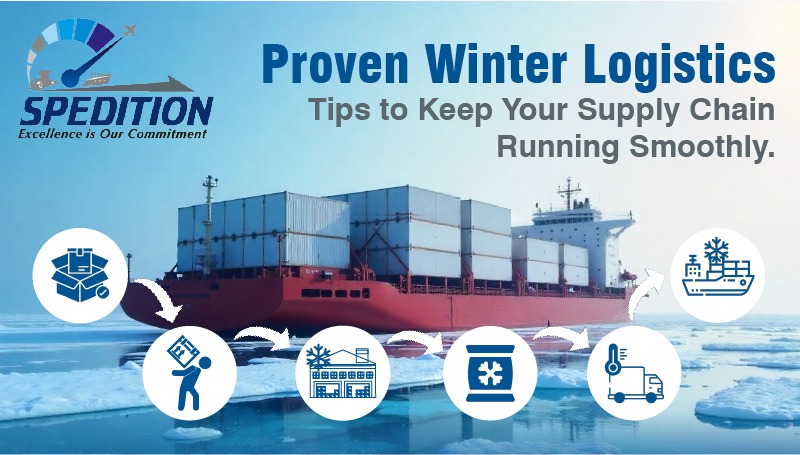
Proven Winter Logistics Tips to Keep Your Supply Chain Running Smoothly

Proven Winter Logistics Tips to Keep Your Supply Chain Running Smoothly

Introduction – When Cold Weather Tests Supply Chain Strength

Winter is pretty, but for logistics companies like Spedition India, it’s a season of obstacles. From icy roads to heavy snow and delayed deliveries, the cold months show how strong — or fragile — your supply chain can be. If you rely on fast deliveries and efficient operations to do business, winter logistics can make or break your brand.

This guide shares proven winter logistics tips and how spedition India helps you maintain operational efficiency, ensure safety, and keep your supply chain moving — even when the weather has other plans.

Understanding the Winter Logistics Challenge

Weather-Related Disruptions

Snowstorms, when they arrive, can close entire transport routes. Icy roads make driving hazardous, and thick fog impairs visibility for both air and road freight. These are the factors that will result in unsteady and uncertain holds which apply torque to the globalized supply chain. This is where Spedition India steps in and aids clients with timely delivery.

Transportation Bottlenecks and Delays

Winter brings chronic rail and port congestion. Ships can be held up because of frozen ports, and trucks face ice-choked highways. This slows the movement of goods and frequently results in inventory stockouts.

Increased Operational Costs 

More fuel, more heating, and more maintenance — winter operations are costly. Businesses spend extra on de-icing, tire replacements, and storage heating, impacting overall profit margins.

The Importance of Winter-Proofing Your Supply Chain

The best way to winter-proof your logistics isn’t merely by simply avoiding disruptions; it’s a matter of anticipating ways to stay ahead. A robust supply chain system reduces risk and customer dissatisfaction, while keeping business expenses in check even through the most extreme weather.

Fleet Maintenance – Keeping Vehicles Ready for the winter logistics 

Regular Inspections and Maintenance Checks

Cold weather affects fuel efficiency, tire pressure, and battery performance. Scheduling routine checks for tires, brakes, and heating systems keeps your vehicles winter-ready.

Essential Winter Logistics Equipment for Fleets

For each vehicle, provide snow chains, antifreeze and deicer in addition to a toolbox for emergencies. Its the small additions that make a big difference when your fleet encounters erratic winter roads.

Driver Safety and Training

Preparing Drivers for Harsh Conditions

Drivers are the engine that drives logistics. Teach them to drive in a defensive manner when there is snow or ice. Encourage the taking of rest stops, wearing of reflective clothing and checking the weather before each route.

Emergency Readiness and Communication Tools

Ensure every driver has access to real-time communication devices and GPS tracking. In case of breakdowns or road closures, dispatchers can quickly reroute or provide support.

Optimize Warehouse and Cold Storage Efficiency

Temperature and Humidity Control

Warehouse insulation in winter is extremely important. You know, if you use smart thermostats or temperature sensors or automated climate systems and don’t spoil your temperature-sensitive goods.

Worker Safety Inside Warehouses

Cool floors could also be slippery and dangerous. Offer anti-slip mats and proper lighting and heating areas where construction workers in the warehouse may slip or trip.

Using Technology for Real-Time Logistics Management

GPS Tracking and Predictive Analytics

Technology allows companies to predict and prevent problems before they occur. GPS systems and AI-based weather analytics help optimize routes and delivery schedules.

IoT Devices and Automation in Cold Chain Logistics

IoT-connected devices track the temperature and humidity of products while in transit, ensuring some level of cold chain requirements are achieved — particularly for medications and perishable food items.

Strengthening Communication and Collaboration

Supplier and Customer Coordination

In addition, strong relationships with both suppliers and customers enable greater coordination during a disruption. This allows all to prepare for potential delays by forecasting jointly.

Transparent Communication During Delays

But if delay is unavoidable, transparency is critical. First Alert: Notify your customers immediately and give updated delivery dates to continue to establish trust and reliability.

Building Supply Chain Resilience Before Winter Hits

Inventory Buffer and Backup Routes

Before winter arrives, stock up on essential goods and map out alternative routes for major delivery corridors. A small buffer can save your operations from long delays.

Strategic Partnerships with Reliable Carriers

Only work with logistics partners like Spedition India that have experience in winter logistics. Proficient carriers are best prepared to get through extreme weather without problems.

Sustainable Winter Logistics Practices in Winter

Cold weather often leads to higher fuel consumption, but sustainable logistics can change that. Use electric or hybrid fleets, optimize routes for minimal idling, and choose eco-friendly packaging materials. These practices save energy and reduce carbon emissions even in tough seasons.

Common Mistakes to Avoid in Winter Logistics

  • Ignoring early maintenance schedules.
  • Failing to plan for alternative delivery routes.
  • Poor communication with customers during delays.
  • Neglecting driver safety training.
  • Overlooking warehouse insulation and temperature control.

Avoiding these common pitfalls ensures smoother operations and fewer surprises during peak winter months.

Conclusion – Stay Prepared, Stay Reliable

Winter logistics can cut down your speed, but with the right logistics partner in way of logistics like Spedition India, one can use obstacles as an advantage. So when you put your money into fleet maintenance, driver safety and technology, you invest in keeping on-the-road time constant and customers happy.

Remember — a resilient supply chain isn’t built overnight, but with the right strategies, it can withstand any storm.

FAQs

  1. Why is winter logistics challenging for supply chains?
    Because of unpredictable weather, icy roads, and temperature-sensitive goods that require special handling. Hold hands with Spedition India and prepare to confront the challenges in a very relaxed manner.
  2. How can I keep my fleet running efficiently during winter?
    Regular maintenance, winter tires, antifreeze, and route optimization are key to preventing downtime.
  3. What role does technology play in winter logistics?
    Technology is used in tracking vehicles and predicting weather disruptions, monitoring product safety and even being aware of what a company is paying.
  4. How do companies maintain warehouse safety in winter?
    By insulating better, keeping humidity under control and with the right anti-slip flooring to avoid accidents.
  5. What’s the best way to communicate with clients during winter delays?
    Be transparent — real-time updates, updated schedules and proactive notifications build trust.

🔹 Ready to strengthen your winter logistics strategy?

Partner with Spedition India, your trusted logistics expert — ensuring smooth operations no matter how cold it gets.
📞 Contact us today and keep your supply chain moving seamlessly this winter!

0 0 Continue Reading →

From Click to Customer: The Complete Guide to Smarter E-Commerce Management

From Click to Customer: The Complete Guide to Smarter E-Commerce Management

E Commerce business owners concentrate on the website, marketing outsourcing, social media pages, and hype. However, those flashy elements only ensure that the business gets a click. The business either succeeds or fails after that click. That’s where logistics comes in, the unsung hero that turns interest into actual gratification and loyalty.

Online stores pose as a promise, “Order with us, and in the bare minimum of time, we will send the item in one piece, and without any hassle.” That can only be achieved through strong freight forwarding companies in India. Without the marketing, all the money spent on marketing will be in vain, and trust will disappear faster than ice-cream in summer.


Part of, The Journey After ”Buy”: What Happens After

There are several steps that are taken after hitting the “Place Order” button that customers do not pay attention to. Order confirmation, payment, inventory approval, payment confirmation, warehouse task designation, and drawing a delivery roadmap all happen in a predetermined order.

Even in the best case scenario, everything takes under a few minutes, but there is always a chance a weaker link could cause a single point failure in the entire process. What if a product is stored in the wrong warehouse? What if there are unoptimized re-stops for deliveries? What if the stock keeping records show the stock is available while in the real world, the stock is out of inventory? Such discrepancies could turn an enthusiastic buyer into a furious buyer.

Logistics is like a hidden relay race for your E Commerce Store. It starts with your e-commerce store, then the warehouse team, factory workers and finally the delivery team. Each of the steps are known as passes and each and every single one has to be executed without any fault. Just like the relay race, if a single runner messes up, the entire team loses.


Logistics store Promising E commerce

Standard of miss everything an E-Commerce promises, including;

Inventory control issues: Lack of real-time tracking makes the company vulnerable to the chances of overselling or under-stocking. Ultimately discourages customer satisfaction.

Poor last mile delivery: Speed is essential. With how fast the world has gotten, if last mile delivery time is too long, consider your E-commerce store as a customer to the nearest competitor.

Managing returns: Integrating returns into a seamless process is a critical aspect of a company’s operational value chain.

Holiday and special promotions: If your logistics are incapable of scaling, a surge in orders will result in sluggish fulfillment and stagnation of orders.

The good news is, all of these challenges can ultimately be solved with the right strategies, tools, and partnerships with specialized supply chain logistics providers.


Streamlined and Fully Functional Inventory Management Systems

A streamlined and functional inventory management system ensures that accurate stock balances are kept with the books, and that stock on hand is matched with the inventory data. Seamless integration with ebay, amazon, and shopify allows real time inventory management, which is crucial in meeting customer expectations. Manual inventory control introduces the risk of errors and customer dissatisfaction due to order cancellations.

Organizations also have to consider other factors of inventory management. From the perspective of an organization, stock should be strategically positioned to reduce shipping time while also being easily accessible to customers. Advanced management systems offer automation that can determine the optimal stock location and provide real time inventory levels.

Specialized AI technologies can assess previous sales data, seasonal demand, and other industry dynamics to place orders at the right time and in the right quantities. AI systems to manage inventory are the latest innovations in retail.


Achieving Optimal Efficiency and Time Savings in Order Fulfillment

Order fulfillment is the stage in the customer journey where expectations are either upheld or broken. A business may choose to have order fulfillment done in-house. While this allows control, it comes at the cost of needing a large physical footprint, staffing, and technology resources. Alternatively, you may choose to work with a third party logistics provider. 3PLs specialize in storing, picking, packing, and shipping orders. These providers have the additional benefit of being able to scale up or down as required.

The need for speed, accuracy, and operational efficiency are all critical. An experienced logistics professional understands the expensive nature of value, and how adding a single wrong item hurts operational and customer service. Automated systems such as packing machines, barcode scanning, and pick-to-light systems are now staples in most warehouses to minimize discrepancies and errors.

Real-world data and results demonstrate the cost and time savings of accuracy through automation. For example, order picking and routing can be done using AI-controlled arms and machines. An example of this showed a reduction of 120 minutes of work to 10. Efficient workflows and increased speed in order retrieval benefit both the customers and the logistics experts—orders can be dispatched and retrieved more quickly.

Last mile delivery is the most pivotal part in a package’s shipment. It is the movement of a package from a local distribution center to the final destination and is regarded as the final stretch of delivery. Certain e-commerce businesses are partnering with local courier services for urban deliveries within the same or the next day. This strategy improves competitiveness without the cost of additional delivery fleets.

Here, transparency is crucial. Customers want the reassurance of real-time tracking and proactive delivery notifications.


Returns Management & Reverse Logistics

E-commerce businesses incur costs for returns, however the returns management process can be orderly. Streamlined processes for returns can enhance sale opportunities because customers are more inclined to purchase when the return process is simple.

The central focus is reverse logistics — swiftly assessing returns, restocking sellable items, and recycling or disposing of unsellable items. The speed at which returned items can be resold depends on reclaimable inventory and the ability to repurpose returned items, turning potential losses into sales recovery.

Some companies enhance customer relationships by offering tailored recommendations and providing store credit or future discounts alongside.


The Impact of Technology on E-Commerce Logistics Efficiency

The effectiveness of e-commerce logistics processes has greatly improved with the adoption of modern technology. E-commerce enterprises benefit from Automated processes, e.g. WMS with inventory control, order processing, and automatic packing of goods. Appropriate route planning minimizes both time and fuel expenses for deliveries.

The full automation of order processing by e-commerce and logistics companies makes it possible for small and medium sized enterprises (SMEs) to compete with market leaders. The automation is achieved through the seamless integration of e-commerce with multi-modal solutions, which trigger picking, packing, and shipping processes upon receipt of an online order.


Sustainable Logistics: The Anticipated Future and Innovative Logistics

E-commerce companies, in particular, need to pay close attention to Sustainable Logistics due to enhanced consumer attention on product purchases. Sustainable logistics focuses on eco-conscious solutions. Businesses can now adopt green packaging, electric vehicle delivery, or carbon-neutral shipping. These solutions enhance company image and boost customer loyalty.

In what seems like an innovation arms race, companies that prioritize these aggressive order prediction and delivery strategies LTE (long term effective) tend to dominate. Businesses that concentrate on these novel delivery methods inevitably outrun their competition.


Conclusion Remarks and Key Findings

For enterprises in the current landscape, the clock starts ticking as soon as the customer engages the “Buy” button. Every second up until the customer receives the order is an opportunity to either “wow” the customer or lose them entirely.

E-commerce logistics is the strategic management of inventory, order processing, the last-mile delivery segment, and returns. With the advent of new technologies, e-commerce logistics is no longer a race against time for speed. With smart e-commerce logistics, precision, and complete visibility during every stage is equally important. Self-fulfillment and the last-mile delivery stage adds more value than the mere transport of order parcels. Firms that invest in e-fulfillment infrastructures do not merely ship boxes. They fulfill the commitment to the customer and achieve retention.


Frequently Asked Questions

  1. What does the term e-commerce logistics imply?
    E-commerce logistics is the accurate order fulfillment of storing, picking, packing, dispatching, and delivering orders made online.
  2. Competing in e-commerce logistics for smaller online stores
    Excellent customer service improves the delivery route collaboration with freight forwarding companies in Bangalore. Improving customer service also enhances the online store’s competitiveness.
  3. High costs affecting last-mile delivery.
    The significant number of stops and high traffic in densely populated areas and expensive labor contribute to high last-mile delivery costs.
  4. E-commerce and the impact of technology
    The implementation of AI e-forecasting and integrated warehouse management systems (WMS) enhances e-commerce logistics by improving accuracy, automation, and processing speed.
  5. Eco-friendly logistics without sacrificing speed
    Sustainable logistics can now also be speedy with the use of electric vehicles outfitted with intelligent route optimization and environmentally-conscious packaging.
0 0 Continue Reading →
devnergy