Skip to Content

Blog Archives

Logistics in Free Trade Zones: Benefits & Regulatory Tips – The Spedition India Perspective

Logistics in Free Trade Zones: Benefits & Regulatory Tips – The Spedition India Perspective

Introduction to Free Trade Zones (FTZs)

Logistics in today’s competitive global market has evolved beyond its original purpose of moving products between two locations. The new logistics system requires businesses to deliver their products to customers while meeting legal requirements and maintaining operational flexibility and financial efficiency. Free Trade Zones (FTZs) provide Indian businesses with a significant advantage for their international expansion needs because these zones deliver multiple benefits when combined with Spedition India as their logistics partner.

What Are Free Trade Zones?

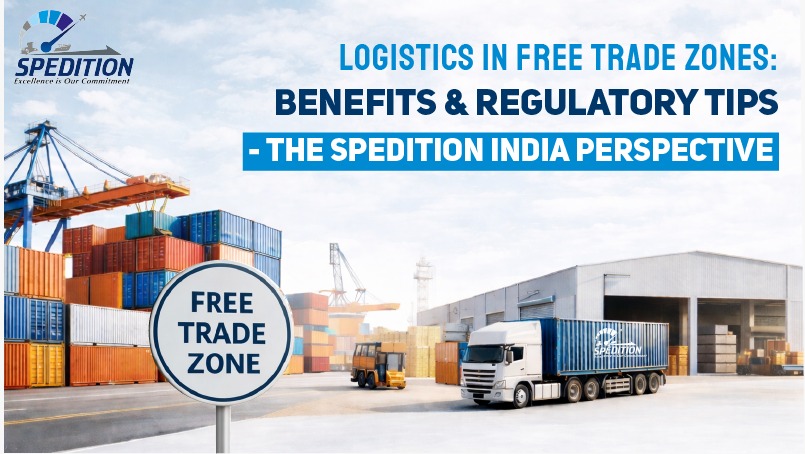
Free Trade Zones function as designated areas which permit the storage and processing and assembly and re-export of imported goods without requiring the immediate payment of customs duties or taxes. From a logistics perspective, FTZs serve as essential hubs which enhance the efficiency of global trade operations.

Why FTZs Matter for Indian Businesses

With India emerging as a global manufacturing and export powerhouse, FTZs help businesses stay competitive. The system decreases trade obstacles while it enhances delivery speed and enables smooth international transit through its partnership with Spedition India, which operates as a reliable logistics provider.

Role of Logistics in Free Trade Zones

Why Expert Logistics Makes the Difference

FTZ benefits don’t unlock themselves. Without proper logistics planning, compliance management, and operational control, businesses can miss out on savings or face regulatory trouble.

How Spedition India Supports FTZ Operations

Spedition India provides extensive knowledge about international freight forwarding services together with customs coordination and warehousing and multimodal logistics operations. The FTZ-focused solutions ensure goods move efficiently while staying fully compliant with Indian and international regulations.

Types of Free Trade Zones Relevant to India

Special Economic Zones (SEZs) in India

India’s Special Economic Zones create export growth through their provision of tax benefits and their implementation of easier customs processes and their delivery of top-notch infrastructure. Spedition India provides complete logistics services to assist its customers who work in Special Economic Zones.

Export Processing Zones (EPZs)

EPZs dedicate their operations to manufacturing activities that support export markets. The combination of Spedition India handling raw material shipments and finished product deliveries enables businesses to achieve better operational efficiency.

Free Ports and Bonded Warehousing

Bonded warehouses allow goods to be stored without immediate duty payment. Spedition India helps businesses leverage bonded facilities to improve cash flow and inventory control.

Key Benefits of Free trade zones Logistics for Businesses

Duty and Tax Advantages

One of the biggest advantages of Free Trade Zones logistics is duty deferral. Businesses only pay customs duties when goods enter the domestic market. For re-exports, duties may be eliminated altogether.

Faster Customs Clearance with the Right Partner

Spedition India uses its customs expertise to deliver faster shipment clearances while decreasing paperwork requirements and shortening all waiting periods.

Improved Cash Flow and Cost Efficiency

The practice of delaying duty payments together with effective inventory management enables companies to maintain working capital which serves as a vital benefit during competitive market conditions.

Supply Chain Flexibility and Scalability

The free trade zone system enables companies to make instant operational changes which they require to meet shifting market needs. The system allows products to undergo repackaging and relabeling and redirection without incurring extra customs fees.

How Spedition India Enhances Free Trade Zones Supply Chains

Reduced Transit and Lead Times

Strategic routing, multimodal transport, and proximity to ports help Spedition India reduce transit times significantly.

Inventory Optimization and Visibility

With real-time tracking and efficient warehouse management, clients gain complete visibility over their Free Trade Zones inventory.

Value-Added Logistics Services

Spedition India offers services like kitting, labelling, consolidation, and quality checks within FTZs—adding value without increasing duty costs.

Industries Served by Spedition India through FTZ Logistics

Manufacturing and Industrial Goods

Manufacturers benefit from duty-free import of components and smooth export of finished products.

Automotive and Engineering Cargo

High-value parts and machinery require precise handling—something Spedition India specializes in.

Pharmaceuticals and Healthcare

With strict compliance requirements, pharma companies rely on Spedition India for secure and compliant FTZ logistics.

E-commerce and Retail Trade

E-commerce brands use FTZs to handle their cross-border operations and returns processing and inventory storage.

Regulatory Framework for FTZ Logistics in India

Indian Customs and FTZ Compliance

FTZs operate under strict customs supervision. While benefits are attractive, compliance is mandatory.

Documentation and Reporting Requirements

Accurate Bills of Entry, shipping bills, and inventory records are critical to avoid penalties.

Common Compliance Risks

Misclassification, incorrect valuation, and poor documentation can lead to delays or fines.

Regulatory Best Practices Followed by Spedition India

Accurate Record-Keeping

Spedition India requires its staff to document all operational activities for verification purposes.

Compliance-Driven Logistics Planning

The team assesses regulations during all delivery processes which begin with route planning and conclude with final delivery.

Technology-Enabled Transparency

The digital tools enable clients to maintain ongoing readiness for audits throughout the entire process.

Technology in Modern FTZ Logistics

Warehouse & Transport Management Systems

Advanced systems streamline operations and reduce manual errors.

Digital Customs Coordination

Electronic documentation speeds up approvals and reduces compliance risks.

Real-Time Tracking and Analytics

Clients benefit from data-driven insights for smarter decision-making.

Challenges in FTZ Logistics and How Spedition India Manages Them

Regulatory Changes

Spedition India stays updated with policy changes to keep clients compliant.

Operational and Security Risks

Security protocols with high strength protect valuable cargo shipments.

Infrastructure Constraints

Strategic planning helps to solve the problems which arise from regional infrastructure limitations.

Strategic Tips to Maximize Free Trade Zones Benefits

Choosing the Right FTZ Location

Spedition India helps clients select FTZs close to ports and markets.

Partnering with an Experienced Logistics Provider

Expertise reduces risks and maximizes savings.

Regular Compliance Audits

Proactive audits prevent costly disruptions.

FTZ Logistics Opportunities in Emerging Markets

India’s Growing Role in Global Trade

With government-backed initiatives, India is becoming a preferred trade hub.

Government Incentives and Trade Policies

FTZ-friendly policies encourage foreign and domestic investment.

Future of Free Trade Zone Logistics

Sustainable and Green Logistics

Spedition India has established its connection to environmentally friendly methods through its choice of cleaner transportation systems.

Smart FTZs and Digital Supply Chains

The development of Free Trade Zone logistics operations is being driven by automation technologies and data analytics capabilities.

Conclusion

Free Trade Zones offer immense potential but their success depends on the establishment of proper logistics systems. Spedition India helps businesses achieve their full potential in FTZ logistics operations through its compliance-driven methods and technology solutions. Spedition India provides businesses with dependable support for their international trade operations through its ability to deliver cost-effective solutions and support worldwide business expansion.

FAQs

  1. How does Spedition India support FTZ logistics?
    Spedition India provides end-to-end logistics, customs coordination, warehousing, and compliance support.
  2. Are FTZs beneficial for Indian exporters?
    Yes, FTZs reduce costs, improve speed, and enhance global competitiveness.
  3. Can Spedition India handle bonded warehousing?
    Yes, Spedition India offers bonded and FTZ warehousing solutions.
  4. What industries benefit most from FTZ logistics?
    Manufacturing, automotive, pharma, and e-commerce benefit significantly.
  5. Is FTZ logistics suitable for long-term supply chain planning?
    Absolutely. FTZs provide flexibility, scalability, and regulatory advantages.
 

0 0 Continue Reading →

Doubling India–Africa Trade & Logistics Partnerships

Doubling India–Africa Trade & Logistics Partnerships

Strengthening Connections. Enabling Growth. Moving Industries Forward.

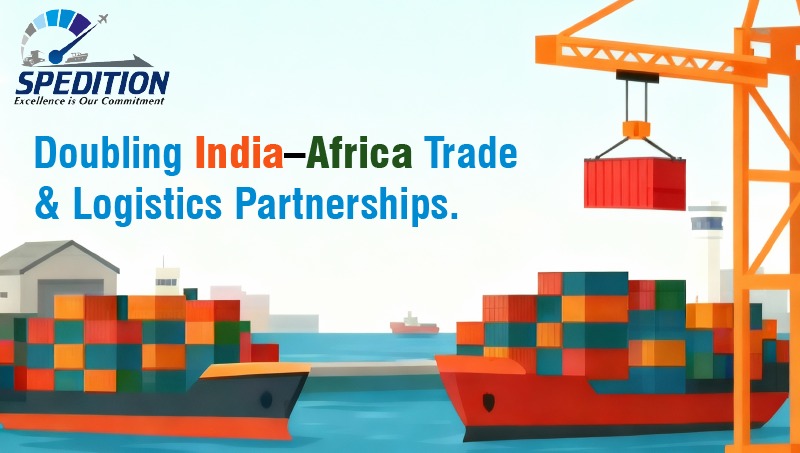
India-Africa trade relations are likely to be one of the most exciting collaborations of the decade. Policies and trade agreements are just a small part of the story of this bubbling partnership. Furthermore, the ports, air routes, and supply chains create a real growth scenario where trade development will be easy. Per the Confederation of Indian Industry (CII), there will be a twofold increase in trade between the two areas by the year 2030, and the foremost factor in this expansion will be logistics, thus making the growth sustainable.

For companies venturing into new markets, logistics is not only transferring goods. It means extension of reliability, tardiness, and trust. At SPEDITION INDIA, we consider every shipment as an obligation – a bond that links people, industries, and chances to the other side of the border.

India–Africa: A Corridor of Opportunity

India and Africa have long been natural trade partners. In recent years, this relationship has diversified — spanning sectors such as pharmaceuticals, renewable energy, machinery, and FMCG. Indian shipments are advancing Africa’s industrial advancement, and Africa’s abundant natural assets back India’s production and power needs.

This shared expansion has forged one of the globe’s most encouraging commerce routes. However, sustaining this pace requires robust, flexible, and reliable supply chain setups. That’s where Spedition India comes in — providing integrated logistics solutions that make trade between India and Africa seamless and efficient.

SPEDITION INDIA: Enabling India & Africa Trade Seamlessly

At Spedition India, logistics means more than transportation — it’s about building lasting connections. Every shipment we move represents a business milestone for our clients. Our India–Africa trade operations combine an extensive network of air and sea routes with local expertise to ensure cargo reaches its destination safely and on time.

The logistics services we offer have specializations in:

  • Air and Sea Freight at access points like ports and airports in India and Africa.
  • Movements and Project Cargo for heavy and specialized equipment.
  • Education and Humanitarian Cargo used for children and adults learning and development of initiatives.
  • Customs Clearance, Last-Mile Delivery, and Warehousing.
  • Multimodal Transport solutions that are time and cost efficient.

Infrastructure, Technology & Trust

While commerce relies on the physical framework, successful logistics flourishes through reliance. Spedition India functions via India’s foremost entry points — Nhava Sheva, Mundra, Chennai, and Delhi — linking these hubs to vital African trading zones across the East, West, and South.

Through cutting-edge shipment monitoring, electronic paperwork, and up-to-the-minute collaboration, Spedition India guarantees total clarity. However, our dependability is not solely built on technology; it’s our personnel who truly matter. Every team member recognizes that logistics involves more than simply transporting goods; it’s about delivering assurance.

Building the Future of India–Africa Trade

The India–Africa trade route is growing faster than ever, powered by investment, collaboration, and innovation. Spedition India continues to invest in stronger partnerships and smarter logistics systems that support this growth. Our approach blends human insight with technological precision — ensuring that every delivery builds trust and strengthens global connectivity.

As both regions expand their economic footprint, Spedition India remains committed to enabling this transformation — helping businesses reach new markets, reduce complexity, and achieve sustainable global growth.

Summary

There is no doubt that the India–Africa trade partnership is among the top trade stories of the modern era. This collaboration in trade is expected to be twice as much in 2030, and Spedition India is playing a key role in this development by providing first-rate logistics solutions. Our expertise in air, sea, and project cargo services ensures smooth, secure, and on-time delivery — empowering industries across continents.

Frequently Asked Questions (FAQ)

  1. Why is the India–Africa trade corridor growing so rapidly?

It’s due to mutual complementarity: India supplies expertise in technology and production, while Africa provides raw materials and developing consumer bases. This equilibrium forms a basis for long-term progress.

  1. How does Spedition India support India–Africa logistics?

Spedition India delivers comprehensive shipping services, spanning air freight, ocean transport, and combined methods. We manage border clearances, paperwork, and secure storage to streamline international transit.

  1. What kind of cargo does Spedition India specialize in?

We manage industrial equipment, project freight, machinery, engineering commodities, educational consignments, and humanitarian assistance with the greatest attention and adherence to regulations.

  1. Which African regions does Spedition India serve?

Spedition India operates across East Africa (Kenya, Tanzania), West Africa (Ghana, Nigeria), and Southern Africa (South Africa, Mozambique).

  1. How can businesses collaborate with Spedition India?

Visit Spedition India to connect with our team, request a quotation, or explore partnership opportunities tailored to your trade needs.

About SPEDITION INDIA

SPEDITION INDIA, an acclaimed logistics and freight forwarding company operating from India, is primarily engaged in Air, Sea, and Project Cargo solutions. With an extensive network covering Asia, the Middle East, and Africa, we facilitate trade and borderless movement of goods in a risk-free manner for various sectors.

Soaked in the ethos of dependency, honesty, and customer-centricity, Spedition India merges the world’s expert knowledge with the local understanding to make supply chains smarter. The company’s vision is crystal clear — to uplift industries, delivery after delivery.

0 0 Continue Reading →

Reducing Logistics Costs: Strategies for Smarter Resource Management

Logistics is one of the primary and core activities of supply chain management and must be performed efficiently in the context of increasing global competition.

Efficiency is one of the core challenges of almost every modern business out there. Fuel cost increases, supply chain interruptions and the ever-increasing amount

of competitors have become a necessity CHECK for a logistics company.

logistics companies in India

Efficient logistics resource management requires a certain degree of strategic planning. Transportation and warehouse management and even technology

use can all be improved to increase profitability. Cost Effective logistics combines all methods and techniques regardless of air freight, ocean freight

or sea freight necessities. This blog highlights key areas that can significantly benefit logistics businesses in India and beyond.

Optimizing Transportation Costs

Route Optimization

Considered one of the most expensive logistical component, transportation costs make up a substantial portion of overall operational costs.

Companies can reduce cost by utilizing AI-enabled route optimization and GPS Tracking systems. Identify peak times and optimize routes to reduce

fuel usage and delivery delays. Improve route efficiency and smart delivery to lower operational costs.

Also Read this : A Complete Guide to the Growing importance of Event Logistics in India

Consolidated Shipments

By merging shipments, one can maximize vehicle utilization and lessen the transportation costs. Freight forwarders based in India

like those in Bangalore and Pune have the ability to merge several shipments going to the same location. This, in turn, helps in reducing the

number of trips needed, saving fuel and reducing costs related to labour,  thus making the entire process cheaper.

Fuel Management Strategies

Fuel costs are one of the biggest expenses for logistics companies. Adopting fuel-efficient vehicles, telematics and driver training programs

can help businesses cut fuel consumption. Moreover, with the help of real-time fuel monitoring systems, businesses can track usage patterns and even identify cost-saving measures.


Warehouse and Inventory Optimization

Strategic Warehouse Placement

Logistics costs can be EXORBITANT for any business if the right placement of warehouses is ignored. By locating them strategically close to

the area of demand, businesses can reduce the costs as well as the delivery time. There is a growing trend in multi-location warehousing

that is observed with logistics companies in India which is meant to fulfil the need of greater efficiency within the supply chain management.

Automation & Robotics

Logistics and warehousing automation are expending modern requirements towards service delivery. The use of robotic pickers along with

conveyors and AI to monitor stock levels improves the speed and accuracy of order fulfilment while reducing labour costs.

The top 10 logistics companies in India are deploying intelligent storage and retrieval systems to enhance operational efficiency.

Inventory Forecasting

Poor inventory management leads to unnecessary holding costs and stock outs. By using AI-powered demand forecasting tools,

logistics businesses can predict inventory needs accurately, prevent overstocking and minimize storage costs.

Freight forwarding companies in India can benefit significantly from data-driven inventory planning.


Leveraging Technology for Cost Efficiency

Transportation Management Systems (TMS)

A Transportation Management System (TMS) offers logistics businesses a solution for managing their freight operations with maximum efficiency.

With TMS, businesses can plan their routes, track shipments and analyse costs resulting in optimized freight forwarding and cost savings.

Top 50 logistics companies in India have adopted TMS to manage their transportation systems more effectively.

IoT and Real-Time Tracking

Devices that are IoT-enabled; permit tracking a shipment in real time which can help decrease losses, stop theft and improve transparency.

Companies with the ability to track real-time will be able to improve the efficiency of their supply chains alongwith customer satisfaction.

Cloud-Based Logistics Platforms

The top logistics companies in India are adopting cloud-enabled solutions as a way of cutting down on IT infrastructure expenses

and improving their logistics planning. Automation, data management and collaboration tools are some of the many things these

Cloud-based technologies offer that have eased the adoption of effective strategic logistics planning.

Reducing Labour and Administrative Costs

Workforce Optimization

Cross-training employees and implementing flexible work schedules can reduce labour costs while maintaining productivity. Logistics businesses

can improve workforce efficiency by adopting automation in repetitive tasks and minimizing manual handling.

Process Automation

Operational productivity is enhanced with the use of AI-powered logistics software with less paperwork and reduced chances of human error.

Customer satisfaction can be heightened with lower costs through automation in invoicing, order processing and chatbots for customer service.

Third-Party Logistics (3PL) Partnerships

Outsourcing logistics functions to specialized Third-Party Logistics (3PL) providers can help businesses save costs on warehousing,

transportation and inventory management. Many freight forwarding companies in Bangalore partner with 3PL providers to enhance

operational efficiency and scalability.


Sustainable Logistics for Long-Term Savings

Green Supply Chain Practices

The implementation of electric powered trucks and the use of renewable sources of energy alongwith biodegradable packaging contributes to the increased

reputation of the Logistics Company and businesses, improving sustainability while reducing the long term operational expenses.

Reverse Logistics Optimization

Handling product returns efficiently is crucial for reducing waste and costs. Businesses can implement AI-driven return management systems to

optimize the reverse logistics process. Top logistics companies in India are investing in sustainable return policies to minimize financial losses.

Carbon Footprint Reduction Initiatives

Reducing the carbon footprint of specific companies entails receiving government perks and tax refund benefits. Solar-powered warehouses,

environmentally friendly shipping materials and fuel-efficient modes of transport are other areas where such companies can cut costs and ultimately contribute.

to making the planet greener.

Negotiating Better Vendor & Carrier Contracts

Strategic Partnerships

Having a premium partnership with freight carriers, suppliers and logistic provider’s means THAT a business avails preferential pricing which assures

best quality. In India, being the best logistics company we specialize in forming strategic alliances to help our clients obtain the most economical offers.

Freight Rate Benchmarking

Regularly comparing freight rates and service quality among multiple vendors helps logistics businesses ensure cost efficiency.

Freight forwarders in India can use data-driven analytics to assess market rates and negotiate better contracts.

Dynamic Pricing Strategies

Leveraging data analytics and AI-driven pricing models can help logistics companies adjust pricing strategies based on market demand,

fuel price and shipment volume? This ensures flexibility and cost savings in freight operations.


Conclusion

Reducing logistics costs is essential for maintaining profitability in today’s competitive market. Businesses must focus on transportation optimization,

warehouse efficiency, technology integration and sustainable logistics practices to achieve cost-effective resource management.

Business automation, route planning with the help of AI technology, the use of the cloud for logistics and even negotiating with vendors can allow companies

to boost productivity, trim expenses and raise client satisfaction levels.

Logistics companies in India, Bangalore, Pune and the surrounding areas need to keep track of popular trends and adjust to new supply chain

problems to be competitive within the industry. These guidance strategies will assist logistics companies to DRIFT successfully in the fast paced marketplace for a prolonged period.

0 0 Continue Reading →
devnergy