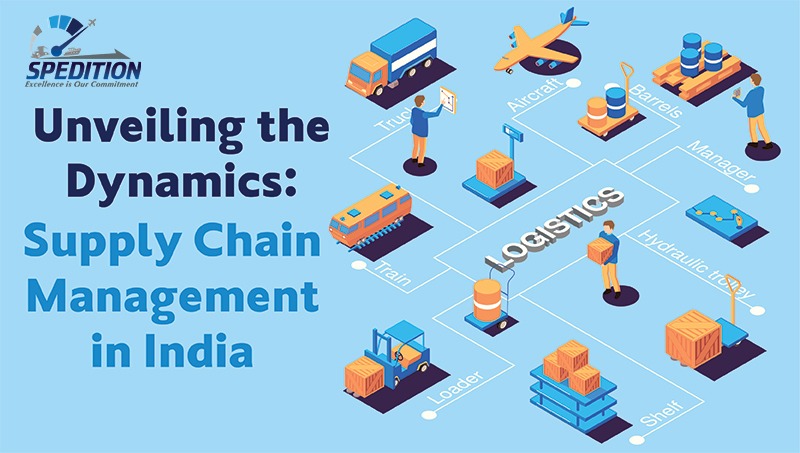
Unveiling the Dynamics: Supply Chain Management in India
Introduction
Getting goods and services to flow freely across myriad industries in India constitutes a complex supply chain management network. This logistical journey is carried forward, with each step finely tuned for maximum efficiency and customer satisfaction-from the lively markets of Mumbai to the full of life ports of Chennai. Freight forwarders act as the unacknowledged conductors, masterminding this logistical symphony, as they wrestle with obstacles such as regulatory complexity and infrastructure bottlenecks.
The blog is to discover the captivating world of supply chain management in India, and it uncovers the invisible powers that make it possible, and at the same time, it provides an analysis of how innovation and technology are changing this essential industry.
Evolution of Supply Chains in India
The development of supply chains in India has moved from traditional systems into modernization and global integration. Indian supply chains were initially fragmented, relying heavily on man work with little technology in it. Globalization and technological advancement have all enhanced the transformation of supply chains in India. With modern supply chain management, efficiency, visibility, and agility have been imparted in different sectors and industries, which have created opportunities for the emergence of top 10 logistics companies in India.
Key Components of Supply Chain Management
The main elements of efficient supply chain management in India are purchasing, production, transportation, warehousing, and selling. The combination of these activities guarantees that there is no interruption in the movement of goods from their raw material stage to the final consumers.Procurement refers to the correct sourcing of materials in terms of price and quality; manufacturing means producing goods in the best possible manner; logistics involve the coordination of transportation and warehousing activities; distribution means acting upon getting goods to the customer’s doorstep on time; while retailing is concerned with merchandising the sold product to drive maximum sales.
These interconnected processes contribute to the success of Spedition India, one of the top 50 logistics companies in India and others striving for excellence in the field.
Challenges Faced in Indian Supply Chains
Despite progress, several challenges hinder seamless operations in Indian supply chains:
- Infrastructure Constraints: Inadequate transportation networks and storage facilities impact logistics management.
- Regulatory Barriers: These cause delays and compliance issues in operations.
- Technology Adoption: Workforce resistance to using tools like automation and data analytics.
Such challenges are felt across key hubs like Pune, Kochi, Coimbatore, and Gurgaon, impacting the operations of even the best logistics companies in India.
Initiatives and Innovations
Several initiatives aim to overcome these challenges:
- Government Efforts: Infrastructure upgrades and streamlined trade procedures.
- Technological Advancements: Autonomous vehicles and AI-driven tools revolutionize operations.
- Private Sector Innovations: Emphasis on collaboration and technology-driven solutions.
These advancements are evident in logistics companies in Pune, logistics companies in Mumbai, and beyond, showcasing how innovation is reshaping the industry.
Impact of Globalization
Globalization has changed the dynamics of foreign trade and promoted international cooperation, which has had a substantial impact on Indian supply chains. The international marketplaces foster growth for businesses beyond their respective nations nowadays. Cross-border trade has witnessed an increase with the introduction of e-commerce platforms, thus making fast and accurate supply chain solutions of utmost importance to manage international shipments.
For example, companies operating as a logistics company in Kochi or a logistics company in Gurgaon are increasingly adopting global strategies to enhance competitiveness.
Sustainability and Green Supply Chains
Sustainability is the primary consideration for almost all companies, including Spedition India, one of India’s top 50 logistics companies. This mounting environmental sentiment is coercing businesses to implement sustainable supply chain processes. Compressing carbon emissions will enhance the corporate image, helping the company to attract environmentally conscious customers.
Digital Transformation in Supply Chains
In supply chain management, the digital revolution is paving the way for inventive advancement. IoT devices enable real-time tracking and monitoring, thus enhancing supply chain visibility. Big data analytics transforms the decision-making process by giving decision-makers useful insights out of vast amounts of data. Also, block chain applications improve security and transparency in transactions between stakeholders to enhance efficiency and build trust in the supply chain.
Future Trends and Projections
The future prospects of technology and robotics are likely to transform supply-chain industry by rapid and precise operations through realization of automation and robotics. The deploying of Artificial Intelligence will be the game changer in supply chain management by advanced features which will lead to better control and forecasting of inventory. This will involve the application of predictive analytics which makes it easy for certain firms to foresee interruptions even before they happen and thus to implement timely measures aimed at boosting operational resilience.
Role of Startups and SMEs
With flexible methods catered to specific markets, startups, and SMEs are essential to bringing about disruption and innovation in the supply chain landscape. Flexibility and creativity allow smaller players to carve unique industry ecosystem positions. The ability to quickly adapt to changing market requirements makes these smaller players strong contenders for redefining traditional logistics paradigms in innovative ways that challenge established practices.
Additionally, creativity is a trait that is deeply rooted in the nature of startups and SMEs; therefore, they promote the development of new ideas. These enterprises, less constrained by tradition, are willing to take risks companies are at the forefront of challenging the existing state of logistics with disruptive innovations such as drone deliveries for last-mile logistics, AI predictive analytics, and Blockchain technology for secure and transparent with new ideas and ways of doing things that are not standard. The time and small-sized transactions.
Education and Skill Development
Education and skill development training programs are the main factors that contribute to the academic curriculums’ improvement for future supply chain professionals. To help them cope with the difficulties of supply chain management easier, students are provided with real-world case studies, industry relevant certifications, and practical experience. In the contemporary business world characterized by rapid changes, the ability to keep up with the latest trends and technologies is a prerequisite for success in such jobs as freight forwarders and logistics managers.
Supply Chain Resilience and Risk Management
Supply chain resilience and risk management have grown into top priorities following worldwide disruptions, such as the recent pandemic. Increasingly in India, top logistics companies are paying attention to pandemic preparedness by implementing acceptable contingency planning to cover vulnerabilities in their supply chains. Agents can then mitigate risks effectively and maintain critical supplies’ continuity through agility, flexibility, and redundancy in core operations. With this proactive approach, the businesses can adjust fast to unexpected challenges and keep working through the crisis.
Collaborative Supply Chain Networks
In today’s global economy, collaborative supply chain networks have completely changed the way firms’ function. Through supplier collaboration and inter-organizational cooperation, businesses can improve efficiency, optimize workflow, and ultimately provide customers with more value.
Freight forwarders play a key role in this interconnected web of logistics, ensuring that goods move seamlessly from suppliers to end-users. The diverse stakeholders in the supply chain ecosystem have a symbiotic relationship that fosters innovation and sustainable growth in addition to increasing responsibility and transparency.
Regulatory Frameworks and Compliance
Active engagement of businesses with regulatory frameworks and compliance standards in all necessary ways is the only way to not only satisfy legal obligations but also to consider the ethical issues that come with supply chain activities. In the first place, absolute compliance with legal norms acts as a shield against risks and losses to reputation, besides giving the company trustworthiness and thus ensuring its survival in the long run. In the present time, it is difficult to imagine business practices without being necessarily ethical, as the environment and society are no longer external factors that can be neglected. Organizations that fuse such principles into their supply chain management will be able to demonstrate that they are able to operate ethically while being in synchronization with changing regulations.
Cultural and Ethical Dimensions
At Spedition India, we always put the cultural and ethical factors first in our supply chain management and logistics operations. Celebrating diversity and inclusion is not just a goal but rather a basic part of our philosophy. A diverse workforce is a source of innovation, broadens our vision by bringing in different perspectives, and thus enhances our ability to cater to the customers’ needs. Our entire supply chain is underpinned by the highest standards of integrity and responsibility as a result of our commitment to ethical sourcing practices. When we engage with suppliers that are like-minded, we establish a network that is not only based on trust and sustainability but that also has a positive impact on our business and the communities we are part of.
Metrics and Performance Measurement
In measuring our performance, we rely on various performance indicators and key performance indicators (KPIs) applicable to logistics and supply chain management. The KPIs assist us in analyzing and optimizing aspects of our operations from managing inventories to transportation efficiencies. We strive for perfection and newness, finally corroborating against industry-level data and benchmarks. By being the frontiers in performance measurement, we ensure that quality service attitudes are instilled in clients, with considerations for cost efficiency and sustainability. Success in the logistics business, according to Spedition India, hinges on the value-adding principle of providing reliability and integrity throughout the process.
Conclusion
To sum up, all the three trends of globalization, technological progress and a shift towards sustainability are contributing quite a lot to the Indian supply chain management area. Innovations and initiatives, even though the hurdles of infrastructure limitations and regulatory barriers still exist, are still paving the way for a more efficient and stronger supply chain ecosystem. The scenario of supply chain management is quickly changing bringing in methods and practices which are compliant with the need of a vibrant global economy, ranging from the rise of cooperative networks and digital transformation to the demand for ethical sourcing.
At Spedition India, we’re dedicated to handling these challenges with dexterity, vision, and a commitment to quality. We continue to set the standard for value-added solutions delivery that promote efficiency, dependability, and integrity throughout the supply chain by embracing global competitiveness and strategic positioning.
Let’s set out on this transformative adventure together, where every obstacle is met with opportunity and each accomplishment is honored as evidence of our group’s resiliency and resolve.

